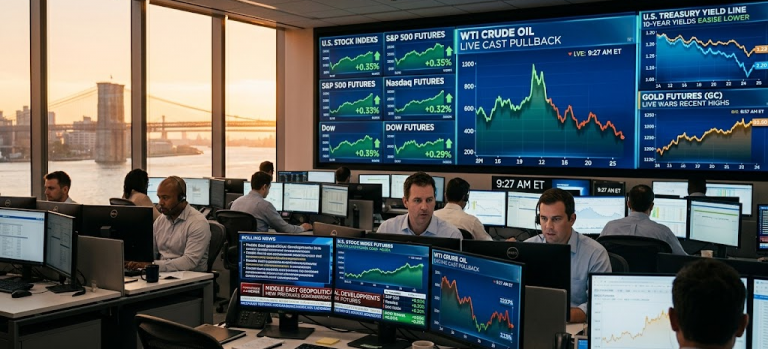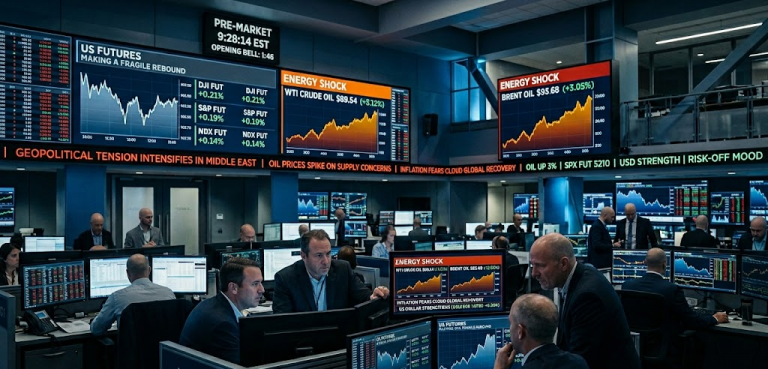





U.S. equity markets staged a powerful rebound during the week of October 13-17, 2025, with major indices recouping all the prior week’s steep losses. But this headline rally masks a deep and troubling fracture in the market.
While stocks rallied on the hope of a U.S.-China trade truce and the expectation of an imminent Fed rate cut, the “smart money” in the U.S. bond market sent the opposite signal: a powerful flight to safety that screamed recession.
This profound anxiety was visible even in the rally. The Cboe Volatility Index (VIX), the market’s “fear gauge,” was erratic. On Friday, it briefly spiked to its highest level since April, a sign that investors were actively buying protection (puts) against a sudden downturn, even as they chased the market higher. This is a classic sign of a low-conviction rally.
The equity market is focusing on the solution the prospect of Fed cuts while the bond market is focusing on the problem the deteriorating economic conditions that would force those cuts.
Market Performance: A Turbulent Rebound
All three major U.S. indices posted strong weekly gains, but the path was defined by extreme intraday volatility driven by geopolitical headlines.
- The S&P 500 advanced +1.70% for the week, closing at 6,664.01.
- The Dow Jones Industrial Average (DJIA) climbed +1.56% to finish at 46,190.61.
- The Nasdaq Composite led the rebound with a +2.14% gain, closing at 22,679.97, as tech stocks recovered from the prior week’s tariff fears.
| Index | Closing Level (10/17/25) | Weekly Change (%) | YTD Change (%) |
|---|---|---|---|
| S&P 500 | 6,664.01 | +1.70% | +13.30% |
| Dow Jones | 46,190.61 | +1.56% | +8.57% |
| Nasdaq Comp. | 22,679.97 | +2.14% | +17.45% |
Sector Deep Dive: A Clear Story in Yields
A look at sector performance reveals the week’s key themes: a dash for yield and a fear of credit risk.
The undisputed leader was the Real Estate (XLRE) sector, which surged +3.6%. This outperformance was a direct consequence of the sharp decline in Treasury yields. Lower borrowing costs benefit the highly leveraged sector, and lower risk-free rates make the high dividends from REITs far more attractive to investors.
The sectors most beaten down by the prior week’s tariff news, Information Technology (+2.1%) and Consumer Discretionary (+1.9%), also posted strong rebounds.
The most telling signal, however, came from the Financials (XLF) sector, which finished the week completely flat (0.0%). Despite a series of strong earnings reports from money-center banks, the sector was paralyzed by emerging fears of credit stress at regional banks, which we’ll cover below.
| Sector | Weekly Change (%) |
|---|---|
| Real Estate | +3.6% |
| Information Technology | +2.1% |
| Consumer Staples | +2.0% |
| Consumer Discretionary | +1.9% |
| Utilities | +1.5% |
| Industrials | +1.2% |
| Materials | +1.1% |
| Energy | +1.0% |
| Healthcare | +0.8% |
| Financials | 0.0% |
The Core Drivers: Geopolitics and a Blind Fed
Two major forces dictated the market’s erratic movements.
Geopolitical Whiplash
The primary driver was the unpredictable U.S.-China trade narrative. After threatening “massive” tariffs the prior Friday, President Trump reversed course over the weekend with conciliatory social media posts, sparking Monday’s rally.
But this is not just a spat over tariffs. The conflict has escalated over rare earth metals. China, which controls ~70% of the global supply, recently imposed new export controls on these minerals, which are critical for AI chips and advanced defense systems. The U.S. tariff threats were a direct retaliation. This has evolved from a simple trade dispute to a strategic battle for technological supremacy.
The Bond Market’s Verdict
The most dramatic development was the powerful rally in U.S. Treasuries. The yield on the benchmark 10-year U.S. Treasury note fell throughout the week, dipping below the psychologically important 4.00% level for the first time since April, closing at 4.02%.
Yields on the 2-year Treasury note, which is highly sensitive to Fed policy, sank to 3.46%—its lowest level in more than three years. This drove the 10-2 year yield spread wider to +56 basis points, a “bull steepening” dynamic that often signals a coming recession as the market bets on aggressive, near-term Fed cuts.
3. A Data Vacuum and a Dovish Chorus
The market’s focus on headlines was intensified by a government shutdown, now in its third week. This has created a “data blackout,” indefinitely postponing the release of the Consumer Price Index (CPI) and Retail Sales.
With no hard data, the market clung to every word from the Federal Reserve.
- The Fed’s Beige Book reported that “Economic activity changed little on balance” and pointed to a cooling labor market.
- Chicago Fed President Austan Goolsbee stated the Fed was becoming “blind” to inflation trends.
- Fed Governors Christopher Waller and Stephen Miran made public remarks supporting another rate cut.
- Fed Chair Jerome H. Powell delivered a technical speech that notably did not push back against the market’s dovish expectations.
This confluence of events cemented the market’s conviction. By Friday, Fed funds futures were fully pricing in a 25-basis-point rate cut at the October FOMC meeting.
Commodities & Earnings: The Canaries in the Coal Mine
The deep anxiety was evident in both commodity and earnings reactions.
Commodities: Gold and oil diverged sharply. Gold futures surged more than 5% for the week, topping $4,300 an ounce in a clear flight to safety. In stark contrast, WTI Crude Oil fell to a five-month low near $57 a barrel on fears of a global supply glut and weakening demand.
Earnings: The Q3 earnings season kicked off with 12% of the S&P 500 reporting. While an impressive 86% have beaten EPS estimates, the market’s reaction was negative.
The reason? The Financials sector. While giants like JPMorgan Chase and Bank of America beat estimates, the market sold the news. Investors were spooked by disclosures from regional banks Zions Bancorporation (ZION) and Western Alliance (WAL). Zions revealed a $50 million charge-off on two Commercial & Industrial (C&I) loans, citing “apparent misrepresentations” by the borrower.
This is the market’s forward-looking nature in action. The strong JPM results are backward-looking. The new regional bank losses are seen as a leading indicator of a broader deterioration in credit quality—confirming the bond market’s fears.
The Week Ahead (Oct 20-24, 2025): A Collision Course
The market’s fragile, hope-fueled rally is set to collide with reality. The data vacuum ends, and earnings season accelerates dramatically.
Economic Calendar: The week’s pivotal event is the delayed release of the September Consumer Price Index (CPI) on Friday, Oct. 24. The last reading for August was 2.9%. A hot inflation number would challenge the entire “Fed cut” narrative and could trigger a sell-off in both stocks and bonds.
The Earnings Gauntlet: A heavy slate of reports from market-leading companies will provide a crucial real-world check on the economy.
| Day | Company (Ticker) | Consensus EPS Est. | Why it Matters |
|---|---|---|---|
| Mon | Zions Bancorporation (ZION) | $1.45 | After the charge-off, all eyes are on their full report and credit outlook. |
| Tue | Netflix (NFLX) | $6.89 | A key read on consumer discretionary spending. |
| Tue | GE Aerospace (GE) | $1.46 | Insight into the industrial and aerospace supply chain. |
| Tue | General Motors (GM) | $2.25 | A bellwether for consumer demand for big-ticket items. |
| Tue | Coca-Cola (KO) | $0.78 | A view on global consumer health and input cost pressures. |
| Wed | Tesla (TSLA) | $0.41 | Commentary on auto demand, margins, and AI. |
| Thu | Intel (INTC) | ($0.12) | A critical update on the state of the global chip industry. |
| Thu | Ford Motor (F) | $0.38 | Another key read on consumer health and the EV transition. |
| Fri | Procter & Gamble (PG) | $1.90 | Can the global consumer absorb further price increases? |
Concluding Outlook: A Potential Collision Course
The market is poised for a potential collision between sentiment and reality. The primary risk for the week ahead is a “stagflationary” shock: if the delayed CPI report comes in hotter than expected while corporate earnings guidance points to slowing growth and margin compression, it would create a challenging scenario for both policymakers and investors, undermining the rationale for the recent rally. Conversely, a combination of benign inflation data and resilient corporate earnings could validate the market’s optimism and provide a more solid fundamental basis for further gains. The interplay between the hard data of the CPI report and the qualitative commentary from corporate management teams on demand, costs, and the outlook will be paramount. Any new developments in U.S.-China trade relations or progress toward resolving the government shutdown will remain critical wildcards capable of overriding all other factors.
Disclaimer: This article is for informational purposes only and does not constitute financial, investment, or legal advice. The information provided is a synthesis of publicly available data and expert analysis and should not be considered a recommendation to buy or sell any security. Investing in the stock market involves risk, including the possible loss of principal. Past performance is not indicative of future results. Readers should consult with a qualified financial advisor to determine an investment strategy that is suitable for their own personal financial situation and risk tolerance.
Sources
- The Fed – Monetary Policy: Beige Book (Branch)
- Speech by Chair Powell on the economic outlook and monetary policy – Federal Reserve Board
- Treasury Yields Snapshot: October 17, 2025 – dshort – Advisor Perspectives