


Morning Market Snapshot December 1, 2025
Global markets turned defensive overnight as investors moved into the first trading session of December with caution. United States equity futures shifted lower in early pre-market trading, reflecting a fragile sentiment that developed across Asia and Europe during the past fifteen hours. Traders are preparing for a day shaped by two primary forces: upcoming U.S. economic releases and a high-impact speech scheduled from Federal Reserve Chair Jerome Powell.
According to Reuters, S&P 500, Nasdaq 100, and Dow futures all traded lower as the new month began, a response to rising uncertainty regarding the path of interest rates and the durability of recent rallies. The tone carries a distinctly protective character rather than broad fear since the market is avoiding aggressive risk but is not yet in full liquidation mode.
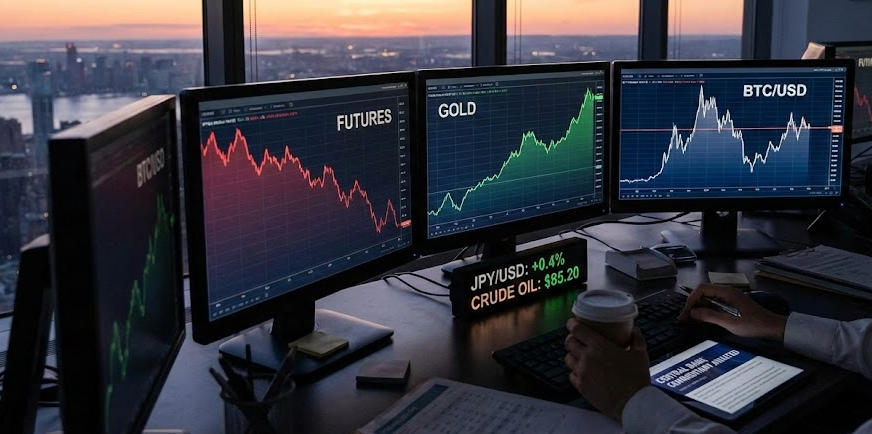
In the cryptocurrency market, traders unwound significant risk exposure following a sharp drop in Bitcoin. The token slid through the 90,000 level as selling pressure built and flowed into traditional safe havens. Reuters reported that Bitcoin fell more than five percent as investors actively reduced exposure to growth-linked assets. The move affected not only digital currency markets but also risk-sensitive equities, particularly speculative technology segments and crypto-linked stocks.
Asian markets followed a similar trajectory. Japanese equities faced heightened volatility after Bank of Japan Governor Kazuo Ueda signaled that a rate increase would be considered at the upcoming BOJ meeting. This commentary strengthened the yen and pressured Japanese and regional equities, reinforcing a global bias toward asset protection rather than expansion.
Commodity markets added another layer of complexity. Oil prices rose following an OPEC+ meeting that affirmed the group would maintain its current output levels. Higher crude prices fed concerns about inflation pressures re-emerging at an inconvenient time for central banks. Gold, meanwhile, climbed to a six-week high as the U.S. dollar softened, and investors sought safety ahead of Powell’s remarks.
The overarching setup for the U.S. session is one defined by hesitancy. Traders are positioning lightly, waiting for clarity from economic data and Powell’s tone before committing to strong directional moves. Overnight signals point toward a market that is cautious yet responsive, sensitive to headlines, and prepared to adjust positioning quickly as new information emerges.
Pre-Market News Catalysts
• Bitcoin-linked equities such as Coinbase and MicroStrategy are under pressure following Bitcoin’s break beneath 90,000, driven by investors withdrawing from risk-heavy exposures. Early morning Bitcoin dropped and is moving back up to around 85,000 as of this morning.
• Energy names are seeing early activity as crude prices bounce after OPEC+ reinforced its output stance, supporting integrated oil companies and producers.
• Japanese ADRs including Toyota and Sony may see volatility during the U.S. session following hawkish commentary from the Bank of Japan that caused yen strength and regional equity weakness.
The Day’s Debate (The Bull vs. Bear Case)

The Bull Case: The bullish interpretation of the overnight environment centers on the belief that the current weakness is primarily precautionary and not a sign of deteriorating economic fundamentals. Supporters of this view suggest that investors are reducing risk exposure ahead of Powell’s remarks and important economic data, not because of any confirmed negative shift in macro conditions. Futures have dipped, but not in a manner characteristic of acute stress. Instead, traders seem to be clearing the deck to better absorb central bank messaging. Reuters noted that U.S. futures fell modestly rather than sharply, which supports the argument that this is controlled positioning rather than forced selling.
Another point for the bullish case concerns the reaction in safe-haven markets. Gold’s climb to a six-week high shows an orderly migration toward safety rather than chaotic panic. A measured shift into gold typically reflects calculated risk management rather than a flight from systemic stress.
Optimists also argue that the decline in Bitcoin and other speculative assets may remove froth from the market and establish a cleaner foundation for future moves. If crypto-linked volatility is largely contained, other sectors could stabilize and even rally once Powell’s comments pass. A controlled unwind in speculative corners often precedes renewed risk appetite in stronger market segments.
The bull case further suggests that once the BOJ clarifies its intentions, global currency markets may settle. A more predictable yen can help reduce cross-border volatility and allow global funds to re-enter equities. In short, bulls expect the pressure to ease once the current wave of uncertainty gives way to clarity.

The Bear Case: Bearish analysts view the overnight action as a warning sign that risk appetite is deteriorating ahead of key policy decisions. Bears believe that the combination of sliding futures, falling cryptocurrencies, rising gold, stronger yen, and firming oil prices represents a broad shift toward defensive positioning that could intensify if Powell delivers even a slightly hawkish tone. The drop in Bitcoin below the 90,000 level is especially concerning for bearish observers since the token often acts as a barometer for speculative appetite. If investors are withdrawing from high-beta assets, sentiment may weaken across technology and growth sectors.
In addition, bears highlight the hawkish commentary from BOJ Governor Kazuo Ueda as a potential spark for wider volatility. A Japanese rate hike would represent a major policy shift that could trigger repatriation flows and pressure global risk assets. Any significant strengthening in the yen often strains carry trades, which can have ripple effects across equity markets.
Bears also express concern about commodity inflation. The OPEC+ decision to maintain its output strategy pushed oil prices higher and could complicate the inflation outlook for central banks. Rising crude is often problematic for rate-sensitive segments such as high-growth equities and can prolong restrictive monetary policy, which in turn weighs on valuations.
From a flow perspective, the combination of weaker futures, higher safe-haven demand, declining crypto, and yen strength resembles the early stages of a global de-risking process. Bears argue that until fresh data or Powell’s tone alleviates concerns, the path of least resistance is lower.
The Strategic Takeaway
The theme heading into the U.S. session is caution driven by uncertainty rather than deterioration. The market is responding to the prospect of important economic data and Powell’s upcoming remarks by reducing leverage and paring back exposure to volatile assets. This creates a delicate intraday setup since participants are reluctant to commit capital without a clearer view of the policy environment and economic momentum. The rise in gold, the decline in crypto, and the firming of the yen all suggest that investors are prioritizing stability as they wait for clarity.
Traders should recognize that today’s risks are headline-driven. The market has positioned conservatively, but it has not shown signs of panic or broad structural weakness. This means intraday volatility could be high as new information arrives, but it also suggests that opportunities for stabilization may appear quickly once market participants digest Powell’s tone and the economic releases. The most important factor to monitor is whether risk assets remain under controlled pressure or transition into more aggressive selling.
Upcoming Session Outlook with Directional Bias
The session is likely to begin with a slightly bearish tone. Futures suggest a soft open, and overnight trading leaned consistently toward safety over risk. The tone may remain tentative through the morning as traders wait for Powell. Technology, crypto-linked stocks, and rate-sensitive growth names could face early selling if the risk-off flow continues.
However, the extent of the downside bias depends heavily on headline timing. If the commentary from Powell is received as balanced or modestly supportive of future easing, the market could shift toward neutral as the session progresses. If Powell signals hesitation toward near-term rate cuts, volatility may increase and reinforce the defensive inclination already visible overnight.
The directional bias for the session is Slightly Bearish, with the expectation that the market opens weak but retains the ability to stabilize later in the day if messaging turns constructive.
Disclaimer: This article is for informational purposes only and does not constitute financial, investment, or legal advice. The information provided is a synthesis of publicly available data and expert analysis and should not be considered a recommendation to buy or sell any security. Investing in the stock market involves risk, including the possible loss of principal. Past performance is not indicative of future results. Readers should consult with a qualified financial advisor to determine an investment strategy that is suitable for their own personal financial situation and risk tolerance.