




Morning Market Snapshot – January 8, 2026
U.S. equity futures are trading in a narrow, defensive range this morning as participants digest a complex mix of geopolitical escalations and shifting fiscal priorities. This morning, futures tied to the Dow Jones Industrial Average and the S&P 500 are down about 0.2 percent. The Nasdaq 100 is following a similar trajectory, down 0.3 percent. This cautious stance follows a volatile Wednesday session where the Dow and S&P 500 pulled back from record highs.
The primary driver of market sentiment is the sudden shift in U.S. defense policy. President Trump has proposed a record $1.5 trillion defense budget for fiscal year 2027. This news has triggered a massive relief rally in major aerospace and defense contractors. These stocks had previously faced pressure following administration threats to restrict corporate buybacks. The reversal in rhetoric suggests a significant commitment to government procurement that provides long-term revenue visibility for the sector.
Simultaneously, the energy market is reacting to the ongoing U.S. military operation in Venezuela. The White House recently announced an initiative to oversee the Venezuelan oil industry indefinitely. This move aims to stabilize global supply and potentially drive crude prices toward a $50 target. While WTI crude is currently trading near $56.80 per barrel, geopolitical uncertainty is creating a “wait and see” environment for broader energy investors.
Traders are also keeping a close eye on the labor market ahead of Friday’s non-farm payrolls report. Thursday morning will bring the latest initial jobless claims data. This follows a disappointing ADP private payrolls report that showed only 41,000 jobs added in the previous period. The contrast between a cooling labor market and resilient services activity, as evidenced by a 54.4 ISM Services PMI reading, leaves the Federal Reserve in a difficult position regarding future rate cuts. Investors should expect a choppy opening session as the market attempts to balance sector-specific euphoria in defense with macro-level anxiety over economic growth.
Pre-Market News Catalysts
- Lockheed Martin (LMT): Shares surged over 8 percent in pre-market trading. The move is fueled by the administration’s $1.5 trillion defense budget proposal for 2027, which reverses recent fears of dividend and buyback restrictions within the sector.
- Applied Digital (APLD): The stock rose 6 percent after reporting fiscal second-quarter revenue of $126.6 million. This represents a 250 percent increase from the prior year, driven by massive demand for artificial intelligence and cloud data center services.
- AST SpaceMobile (ASTS): Shares fell more than 12 percent following a downgrade to “Underperform” by Scotiabank. Analysts cited valuation concerns after a significant run-up in the stock price over recent months.
- Intel (INTC): The semiconductor giant gained over 6 percent following new product announcements at the Consumer Electronics Show. The introduction of the Core Ultra Series 3 chips has renewed investor confidence in Intel’s competitive position in AI hardware.
The Day’s Debate (The Bull vs. Bear Case)
The Bull Case: The optimistic outlook for 2026 is anchored in robust corporate earnings and the maturing of the artificial intelligence supercycle. Analysts from J.P. Morgan Global Research maintain a positive stance on global equities, forecasting double-digit gains. They estimate that AI-driven efficiencies will support earnings growth of 13 to 15 percent for the S&P 500 over the next two years. The massive $1.5 trillion defense budget proposal serves as a secondary pillar for the bull case. It provides a guaranteed floor for industrial production and high-tech manufacturing. Furthermore, the “One Big Beautiful Bill Act” is expected to inject significant fiscal stimulus into the economy during the first half of the year. This could add nearly a full percentage point to GDP growth. Bullish experts argue that the recent pullback is a healthy consolidation after record highs. They believe the market is simply rotating from mega-cap tech into cyclical sectors like defense and value-oriented industrials. With the S&P 500 having a historical 75% probability of rising in any given year, the current momentum in capital expenditures suggests the path of least resistance remains upward.
The Bear Case: Pessimistic observers point to a troubling “stall” in the labor market as a primary reason for caution. The recent ADP data showing a meager 41,000 jobs added suggests that private sector hiring is cooling faster than many anticipated. This labor weakness is compounded by “sticky” inflation that has hovered around 3 percent with little sign of reaching the Federal Reserve’s target. Bearish strategists warn that the Fed may be unable to cut rates as aggressively as the market expects if inflation remains persistent. Geopolitical risks are also at a multi-year high. The U.S. military involvement in Venezuela and the resulting “indefinite” oversight of its oil industry create unpredictable variables for global trade and energy costs. Additionally, looming tariff concerns and the potential for a “trade war” with major partners like China threaten to compress corporate margins. If consumer purchasing power continues to erode due to softening income growth, the high valuations currently seen in the equity markets may become unsustainable. Bears argue that the market is “priced for perfection” and remains highly vulnerable to any further cooling in economic data or geopolitical shocks.
The Strategic Takeaway
The single most important factor for investors to monitor today is the aggressive rotation into the defense and aerospace sectors. This move signifies a broader shift in market leadership, with government spending and fiscal policy taking precedence over traditional tech momentum. While the headlines about Venezuela and the $1.5 trillion budget are sensational, they reflect a fundamental change in “risk-on” appetite. Investors should be wary of chasing the initial pre-market spikes and instead look for sustainable volume in these newly favored sectors. The divergence between strong services data and weak private payrolls suggests the “Goldilocks” scenario of 2025 is facing its first true test in 2026. A strategic approach today involves protecting gains in overextended tech names and considering exposure to companies with direct ties to the new federal spending priorities. Keep a close watch on the 10-year Treasury yield, which currently sits near 4.14 percent. Any significant move in yields following the jobless claims report could easily overshadow the sector-specific news. Balance and selectivity are the requirements for this session.
Upcoming Session Outlook with Directional Bias
The market is poised for a Neutral-to-Slightly Bearish open as participants weigh the explosive gains in defense stocks against broader macroeconomic concerns and geopolitical uncertainty. While the defense sector will likely provide a significant boost to the Dow, the wider S&P 500 and Nasdaq are under pressure from a cooling labor market and a general retreat in risk appetite. Futures indicators suggest that the initial euphoria over the defense budget may be partially offset by selling in interest-rate-sensitive sectors. Unless the initial jobless claims data provides a surprisingly positive catalyst, the market is likely to trade sideways as it awaits the comprehensive December jobs report on Friday. Investors should expect high volatility in energy and defense names while the broader indices struggle to find a clear direction in early trading.
Disclaimer: This article is for informational purposes only and does not constitute financial, investment, or legal advice. The information provided is a synthesis of publicly available data and expert analysis and should not be considered a recommendation to buy or sell any security. Investing in the stock market involves risk, including the possible loss of principal. Past performance is not indicative of future results. Readers should consult with a qualified financial advisor to determine an investment strategy that is suitable for their own personal financial situation and risk tolerance.
Sources
- US pre-open: Futures slip as risk appetite weakens on geopolitics, jobs data
- Why is LMT Stock Surging? Lockheed Martin Up Over 8%
- US Stock Market Today S&P 500 Futures Edge Lower On Mixed Growth Signals
- North American Morning Briefing: Stock Futures Fall as Rally Stalls
- Applied Digital Reports Fiscal Second Quarter 2026 Results
- 2026 Market Outlook | J.P. Morgan Global Research
- The bull case for stocks in 2026 – Rangvid’s Blog
9. SEO Keywords
Stock market news today, Lockheed Martin stock surge, defense budget 2026, Venezuela oil geopolitics, S&P 500 pre-market, initial jobless claims, Applied Digital earnings, AI stock rally, market rotation 2026, financial intelligence briefing.
10. AI Image Prompt
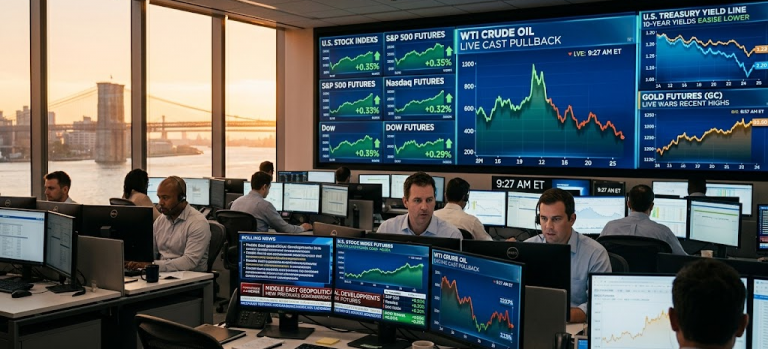
A cinematic, wide-angle shot of a high-tech financial trading floor at dawn. In the background, large holographic screens display rising green charts for defense and aerospace stocks alongside a world map highlighting Venezuela. In the foreground, a professional trader in a sharp suit stands calmly, silhouetted against the glowing blue light of multiple monitors showing complex market data. The atmosphere is one of focused intensity and strategic calculation, with the early morning sun filtering through floor-to-ceiling windows of a New York skyscraper. 8k resolution, photorealistic style, dramatic lighting.