



Morning Market Snapshot – March 19, 2026
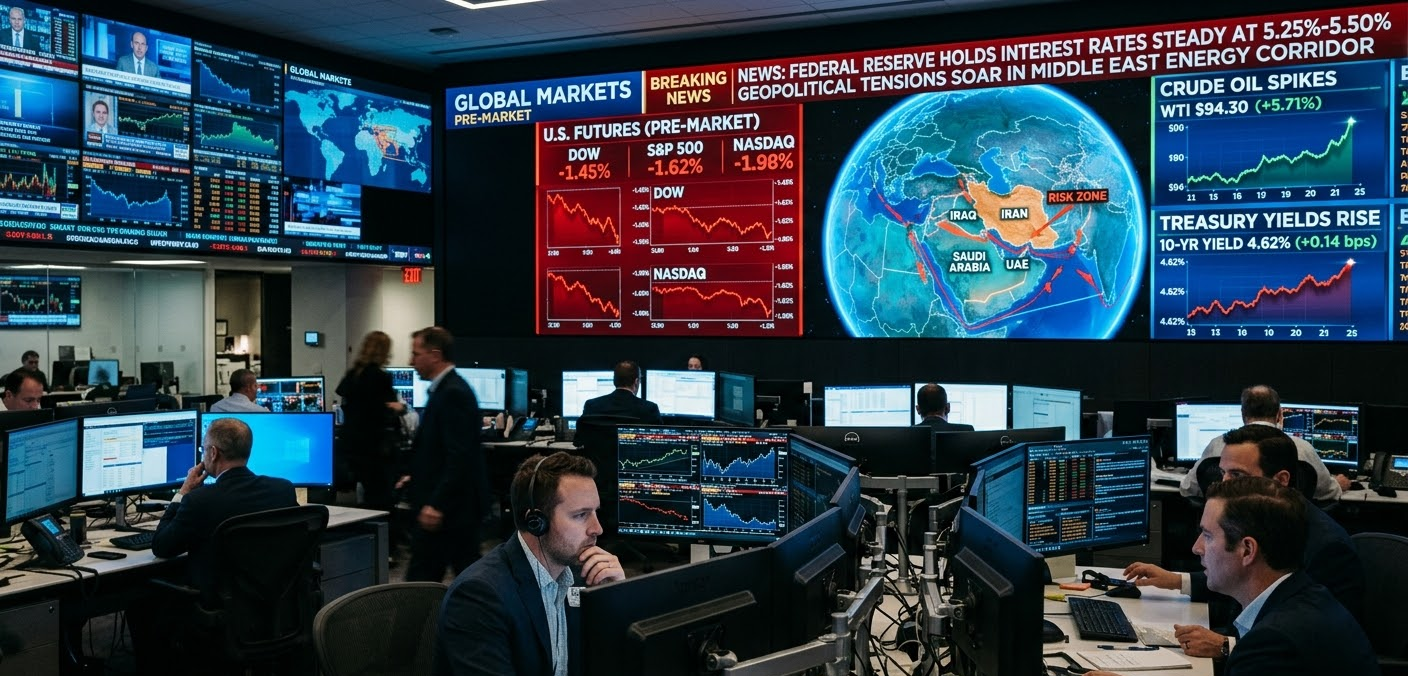
The overnight market story is clear: traders came in facing a fresh energy shock, a Federal Reserve no longer viewed as a near-term safety net, and a pre-market tape that is rewarding very little beyond select value and defensive setups. The dominant driver was a sharp jump in crude after further attacks on Middle East energy infrastructure, which pushed Brent toward $115 a barrel and reinforced fears that inflation could stay hotter for longer. U.S. stock-index futures were lower in early trading, with Dow futures off 0.29%, S&P 500 futures down 0.34%, and Nasdaq-100 futures down 0.48% in Reuters’ snapshot.
That macro shock landed only hours after the Fed held rates steady and stuck with a restrained easing outlook. Chair Jerome Powell signaled that the central bank sees higher inflation risk from energy, and markets responded by pushing rate-cut hopes further out. Reuters reported that Morgan Stanley joined Goldman Sachs and Barclays in moving its expected first cut to September from June, while LSEG pricing pointed to only a very modest easing path. That matters because this market had been relying on the idea that weak growth would eventually force faster easing. Overnight, that assumption looked less secure.
The broader tone across global markets matched that caution. European equities fell sharply, with the STOXX 600 down 2%, and Reuters also highlighted a 14-month run of positive global economic surprises that now faces its first real stress test from the latest oil spike. In other words, the market is trying to decide whether this is a temporary geopolitical scare or the beginning of a stagflation-style reset in positioning.
For U.S. traders, the key thing to watch into the bell is whether the overnight weakness remains concentrated in rate-sensitive growth and consumer names, or whether the selling broadens again. Wednesday already left technical damage, with the Dow and Nasdaq slipping below their 200-day moving averages and the S&P 500 hitting a four-month low. Pre-market action suggests investors are still de-risking rather than bargain hunting. AI enthusiasm remains in the background, but even strong semiconductor earnings were not enough to override macro stress overnight.
Pre-Market News Catalysts
- Micron Technology (MU) fell about 4.5% pre-market despite a strong outlook, because investors focused on a much higher capital-spending plan. Reuters said Micron lifted fiscal 2026 capex by $5 billion to more than $25 billion, overshadowing earnings and guidance that beat expectations.
- Accenture (ACN) dropped about 3% pre-market after issuing a cautious revenue forecast, even though quarterly revenue and EPS beat estimates. Reuters said enterprise customers remain cautious about spending on large-scale IT transformation.
- Five Below (FIVE) was one of the brighter pre-market spots, rising about 8% after stronger profit and sales, according to the Wall Street Journal’s market live coverage.
- SanDisk (SNDK), Western Digital (WDC), and Nvidia (NVDA) also traded lower in sympathy with Micron and the broader tech risk-off move, according to Reuters.
The Day’s Debate (The Bull vs. Bear Case)

The Bull Case: The optimistic read is that the market is absorbing a geopolitical oil shock, not a structural collapse in growth. The strongest support for that view comes from the fact that the global economy had been consistently outperforming expectations before this latest escalation. Reuters reported Citi’s global economic surprise index has stayed positive since January 2025, marking the longest such run since the financial crisis era. That suggests the underlying economy has been more resilient than forecasters expected.
There is also a case that the U.S. economy can tolerate this oil move unless it becomes both larger and longer lasting. The Wall Street Journal reported that economists in its latest survey see recession risk at 32% over the next 12 months, up from 27% in January, but still not their base case. The same survey suggested oil would likely need to rise above about $138 a barrel and stay there for roughly 14 weeks before recession odds move decisively above 50%. That threshold matters because it implies today’s shock, while serious, is not yet automatically recessionary.
There is also still an earnings argument for bulls. Barron’s reported Goldman strategist Ben Snider remains constructive on U.S. equities because AI-related capital spending is still translating into profit growth, with Goldman expecting 12% earnings growth in 2026 and AI accounting for 40% of expected S&P 500 earnings growth this year. Even this morning’s Micron reaction can be read through that lens: the company’s numbers were strong enough that investors are no longer questioning demand, only the cost of feeding it.

The Bear Case: The bearish case is more immediate and more visible in overnight pricing. Oil is not simply rising because of headline risk. It is rising because actual energy infrastructure has been hit, and that is exactly the kind of supply shock that can squeeze growth while lifting inflation. Reuters said Brent hit $115, while MarketWatch reported Brent around $113.58 with damage concerns tied to Qatar’s Ras Laffan industrial complex and Iran’s South Pars gas field. That is why futures weakened rather than shrugged off the move.
The Fed compounds that pressure. Powell did not offer a rescue narrative. Reuters quoted Comerica’s Bill Adams, who said the “big takeaway” is that the Fed will not ride to the economy’s rescue if fuel costs keep climbing, because monetary policy cannot offset an energy supply shock. Reuters separately noted that investors now face a “cloudier” policy path, with only 14 basis points of easing priced by year-end in one snapshot. That leaves equities exposed if both inflation and growth disappoint together.
Technically, the market also looks fragile. Reuters noted that Wednesday’s post-Fed selloff pushed the Dow and Nasdaq below their 200-day moving averages, while the S&P 500 touched a four-month low. When strong earnings from Micron still result in a lower stock price, that is often a sign that macro conditions are dominating fundamentals. Add in weakness in travel names, miners, and broader cyclical areas, and the market looks less like a healthy dip and more like a repricing of inflation risk.
The Strategic Takeaway
The single most important thing to keep in mind before the opening bell is that the market is no longer debating whether geopolitics matters. It is debated whether the oil price spike becomes persistent enough to rewrite the 2026 rate-and-earnings narrative. Overnight trading suggests investors are treating this as a macro event first and a stock-picking session second. When oil surges, rate cuts get pushed out, and even clean earnings beats fail to lift sentiment, the burden of proof shifts to the bulls. For today, price action in crude, Treasury yields, and the first hour of sector leadership will likely tell you more than any single company headline.
Upcoming Session Outlook with Directional Bias
My directional bias into the U.S. open is Slightly Bearish. The overnight synthesis points to a market facing three simultaneous headwinds: higher energy prices, fewer near-term Fed cuts, and a fragile technical backdrop. There is still enough underlying economic resilience to prevent a full panic narrative, but the pre-market tone suggests traders are leaning defensive until oil stabilizes and the inflation impulse looks less threatening. The most likely early-session character is cautious, headline-sensitive, and rotation-heavy rather than broadly risk-on.
Disclaimer: This article is for informational purposes only and does not constitute financial, investment, or legal advice. The information provided is a synthesis of publicly available data and expert analysis and should not be considered a recommendation to buy or sell any security. Investing in the stock market involves risk, including the possible loss of principal. Past performance is not indicative of future results. Readers should consult with a qualified financial advisor to determine an investment strategy that is suitable for their own personal financial situation and risk tolerance.
Sources
- Reuters: U.S. stock futures dip as soaring oil prices, Fed outlook spook investors
- Reuters: Micron shares slip as hefty spending plans eclipse strong AI-fueled earnings
- Reuters: Citi’s surprise index shows longest upside run since financial crisis, awaits war impact
- Reuters: Investors face cloudier Fed rate view as Iran war grips markets
- Reuters: Morning Bid: Gas field grief
- MarketWatch: S&P 500 futures fall as Brent oil touches $114
- Wall Street Journal: Higher for Longer? Heard on the Street Wednesday Recap
- Wall Street Journal: Stocks to Watch Today: Micron, FedEx, HSBC
- Financial Times: FirstFT: Energy prices surge after Iran strikes Qatari LNG site
- Financial Times: Federal Reserve chief Jay Powell says Iran oil crisis will worsen US inflation
- Barron’s: The AI Payoff Is the ‘Biggest Question’ for U.S. Investors, Says Goldman’s Snider