



Morning Market Snapshot – March 26, 2026
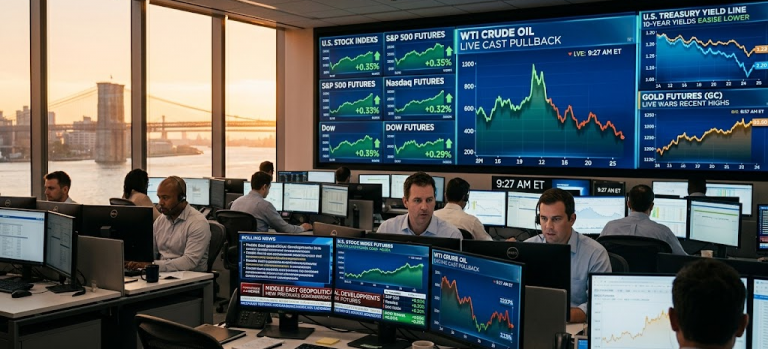
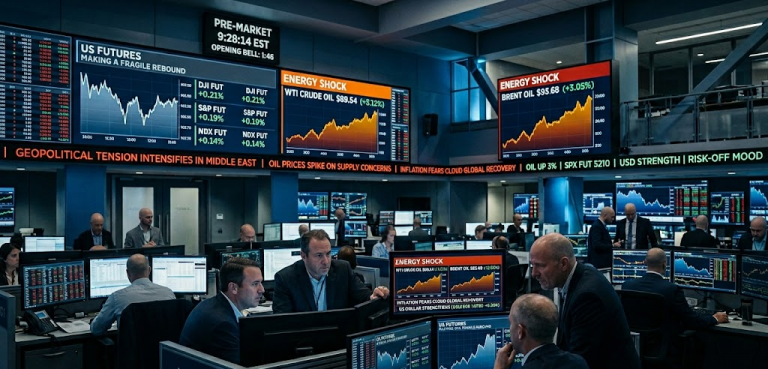
Overnight, the market’s center of gravity swung back to the same issue that has dominated risk pricing for weeks: the Middle East conflict and its effect on energy, inflation, and interest-rate expectations. By early Thursday, U.S. stock futures were under pressure again, with Dow futures down about 0.52%, S&P 500 futures down 0.59%, and Nasdaq 100 futures down 0.73%, as traders lost confidence that a clean de-escalation is close at hand. Reuters also reported that Brent moved above $100 and WTI into the low $90s, while another Reuters-syndicated market update showed Brent around $100.46 and WTI around $93.29 in Asian trading.
The overnight tone was not just about crude itself. It was about the knock-on effect. Treasury markets remained uneasy, with the U.S. 10-year yield around 4.385% and the 2-year near 3.93% in the Reuters-syndicated market update, while a separate Reuters analysis said the MOVE index has climbed to its highest level since May of last year and that Morgan Stanley has seen two-year Treasury bid-ask spreads widen by about 30%. That matters because it shifts the story from a simple geopolitical scare to a broader problem of financial conditions.
Asia and Europe reflected that stress overnight. Reuters said the MSCI Asia-Pacific index outside Japan was on track for its worst month since 2022, while Europe’s STOXX 600 was falling Thursday morning after a short-lived rebound on Wednesday’s peace hopes. The dollar stayed firm, even after easing slightly in Asian trading, and gold failed to act like a classic haven, with spot bullion down 1.4% and gold futures off 2.5% as higher yields and fading rate-cut hopes undercut demand.
What traders should focus on before the bell is whether the market treats this as another temporary oil shock or as a more durable inflation shock. Bloomberg’s Markets Daily said BlackRock President Rob Kapito thinks markets may still be underpricing the risk that oil spikes further and dents growth while lifting inflation. At the same time, the rates market remains jumpy enough that even small changes in the ceasefire narrative could produce outsized moves in crude, yields, and equity futures. On today’s calendar, weekly jobless claims are due at 8:30 a.m. ET, with consensus near 210,000.
Pre-Market News Catalysts
- Olaplex (OLPX): Shares were up roughly 47% to 48% in premarket trading after Henkel agreed to buy the company in a $1.4 billion deal, or about $2.06 per share, a sizable premium to the prior close.
- Arm Holdings (ARM): Arm surged after unveiling its first in-house AI data-center chip and projecting that the product line could generate about $15 billion in annual revenue within five years. Reuters said the stock jumped as much as 20%, while Barron’s and MarketWatch both framed the move as a major strategic pivot into merchant silicon.
- Newmont (NEM): Gold miners, including Newmont, were weaker in the premarket as bullion fell more than 2% and investors favored the dollar and higher yields over precious metals.
- Meta Platforms (META) and Alphabet (GOOGL): WSJ said both names were under modest premarket pressure after losing a landmark social-media addiction case, adding an idiosyncratic legal overhang on top of the broader macro risk backdrop.
The Day’s Debate Bull Vs. Bear Case

The Bull Case: The optimistic argument is that markets are still fundamentally trading a headline-sensitive oil shock, not a full macro regime change. Reuters reported that traders had already shown on Wednesday how quickly they would add risk when ceasefire hopes improved, with global stocks rallying and oil and bond yields falling. Reuters’ currency coverage also quoted Electus Financial’s Mike Houlahan saying that if a ceasefire or truce materializes and oil falls sharply, the inflation premium currently embedded in rates could disappear very quickly.
MarketWatch added another constructive angle, citing HSBC strategist Duncan Toms, who argued that sentiment toward Europe is too bearish and that a de-escalation could unlock a 7% to 8% rebound. There is also a micro-level support story in tech and M&A: Arm’s move into AI CPUs revived enthusiasm for AI infrastructure beyond Nvidia, and the Olaplex deal showed that corporate buyers are still willing to pay premiums for targeted assets. In this reading, the overnight weakness is real, but it remains reversible if crude rolls over and rates stabilize.

The Bear Case: The bearish interpretation is that the market is still underestimating the duration and transmission channels of this shock. Reuters said oil and European gas are up roughly 45% and 70% on the month, the Treasury market is showing signs of strain, and the Asian equity complex is suffering its worst monthly performance since 2022. Reuters also noted that markets now see only a 3% chance of a Fed cut by December, while the Reuters-syndicated currency update showed investors increasing the odds that the Fed simply stays on hold all year.
Bloomberg’s Rob Kapito warned that markets may still be underpricing the risk of a sharper oil spike, even if the war ends soon. That view is reinforced by the fact that gold did not behave like a clean safe haven overnight, a sign that higher real yields and dollar strength are overwhelming traditional defensive trades. The bear case, then, is not just lower stocks because of war headlines. It is stickier inflation, tighter financial conditions, rising rate volatility, thinner Treasury liquidity, and a market that still has not fully repriced what a prolonged energy shock means for multiples and growth.
The Strategic Takeaway
The most important thing to keep in mind before the opening bell is that oil is now the transmission mechanism, not just the headline. As long as crude remains elevated, traders will keep marking up inflation risk, pushing Treasury yields higher, and demanding a lower valuation for long-duration assets, especially growth stocks. If crude falls, the whole chain can partially unwind. If crude holds or rises, the overnight pattern likely persists. That is why futures, bond yields, and the dollar have been moving together. The market is no longer simply debating geopolitics. There is a debate about whether this has become a durable inflation event.
Upcoming Session Outlook with Directional Bias
Directional bias: Slightly Bearish. The pre-open setup points to a softer start because U.S. futures are down, oil is back above psychologically important levels, Treasury stress remains visible, and the ceasefire story has lost credibility overnight. A reversal is possible if fresh headlines ease energy fears, but the overnight evidence favors a cautious, lower open rather than a clean risk-on rebound.
Disclaimer
Disclaimer: This article is for informational purposes only and does not constitute financial, investment, or legal advice. The information provided is a synthesis of publicly available data and expert analysis and should not be considered a recommendation to buy or sell any security. Investing in the stock market involves risk, including the possible loss of principal. Past performance is not indicative of future results. Readers should consult with a qualified financial advisor to determine an investment strategy that is suitable for their own personal financial situation and risk tolerance.
Sources
- Reuters, U.S. stock futures and premarket movers.
- Reuters, global markets wrap and Europe morning note.
- Reuters, Treasury stress analysis and gold markets.
- Bloomberg Markets Daily, Rob Kapito on underpriced oil risk.
- MarketWatch, HSBC’s de-escalation rally case and oil near $100.
- WSJ, stocks to watch and legal overhang for Meta and Alphabet.
- Barron’s and Reuters on Arm’s AI chip pivot.
- Benzinga on Olaplex deal terms.
- Yahoo Finance and Reuters-syndicated market updates.