Most traders do not sabotage themselves because they know nothing.
They usually know the basics. Use a stop loss. Manage risk. Avoid revenge trading. Do not chase. Follow the plan.
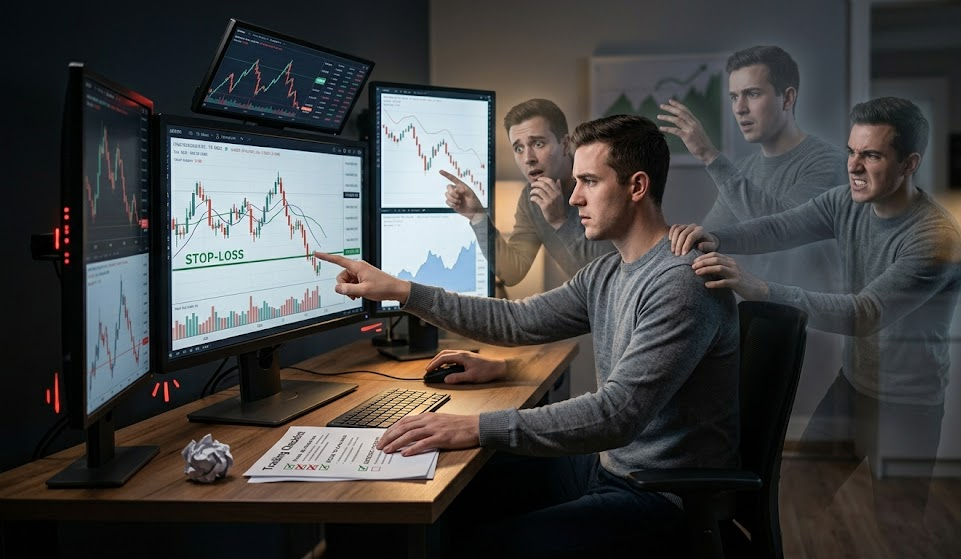
The problem is that knowing the rules is not the same as having emotional trading control when real money is on the line.
That is where many traders get frustrated. They are not confused about what they should do. They are frustrated because they know what to do, but in the moment, they still break their own rules.
That gap between knowledge and execution is where trading psychology becomes real.
Why Live Trading Feels Different From Paper Trading
Paper trading is useful. It helps you learn the mechanics of entering orders, reading charts, testing setups, and understanding how a trading plan might work.
But paper trading does not fully recreate the emotional pressure of live trading.
In a paper account, losses are theoretical. Mistakes may be annoying, but they do not hurt the same way. It is easier to follow your rules because there is no real financial consequence. You may start to believe you are more disciplined than you actually are.
Live trading changes the emotional environment.
When real money is involved, losses feel real. Profit starts to feel like money you already own. A move against you can feel personal. A normal pullback can feel like a threat. A winning trade can tempt you to abandon your target because greed wants more.
This is why emotional trading control matters. Paper trading may teach the process, but live trading tests the operator.
How Fear, Greed, and Pain Override the Plan
Most trading plans do not fail because the trader forgot the plan. They fail because emotion short-circuits execution.
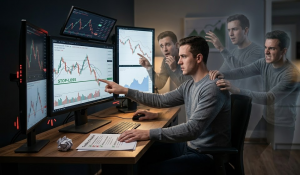
Fear shows up when the trade moves against you
Fear can make a trader exit too early, move a stop, freeze, or avoid the next valid setup.
The market may only be testing a normal level, but the trader feels pressure. Instead of executing the plan, they react to discomfort.
Greed shows up when the trade moves in your favor
Greed can be just as dangerous as fear.
A trader hits the planned target, but instead of taking profit according to the plan, they hold for more. Then the trade reverses. A winner turns into a loser, not because the setup was bad, but because the trader changed the plan while emotion was high.
Greed can also lead to sizing up too quickly, chasing another trade, or taking a setup that does not really fit the rules.
Pain shows up after a loss
Pain is often where the worst decisions happen.
After a loss, the trader wants relief. They want to make it back. They want to erase the mistake. That emotional state can lead to revenge trading, doubling down, breaking the daily loss limit, or continuing to trade long after the best decision would have been to stop.
This is the emotional side of trading that many traders underestimate. Fear, greed, and pain are not random. They are predictable. If you do not have safeguards in place before they appear, they can take control of the decision.
Emotional Trading Control Starts With Simple Rules
Trading rules are not there to restrict you. They are there to protect you from yourself.
A trader does not need a complicated rulebook to start improving emotional trading control. They need a few protective rules that are clear before the trade begins.
1. Define the trade before entry
Before entering, know the entry, stop, target, risk, and invalidation point.
Do not enter first and figure it out later. Once you are in the trade, emotion has a stronger voice. The cleaner decision usually happens before money is at risk.
2. Risk small enough to stay calm
If the possible loss is large enough to make you break your plan, the position size is too big.
This is one of the simplest and most important rules in trading psychology. Oversizing turns normal market movement into emotional pressure. Smaller risk gives you more room to think clearly.
3. Use a daily loss limit
Decide in advance when the trading day is over.
A daily loss limit protects your account, but it also protects your discipline. Without a stopping point, one bad trade can turn into a bad session. One bad session can turn into emotional damage that carries into the next day.
4. Stop after rule breaks
A losing trade that followed the plan is acceptable. A winning trade that broke the plan is still a problem.
This is hard for many traders to accept. A rule-breaking winner can train bad behavior. It tells the trader, “I got away with it.” Over time, that can become more dangerous than a clean loss.
5. Do not redesign the plan mid-trade
Refine your trading plan after the session, not when emotions are high.
When you are in a live trade, the goal is execution. After the session, when you are calm, you can review what worked, what failed, and what needs to change.
Discipline Is Trained, Not Automatic
Discipline is not about being emotionless.
A disciplined trader still feels fear. They still feel greed. They still feel frustration after a loss. The difference is that they notice the emotion without automatically obeying it.
Discipline means taking the planned stop even when it hurts. It means taking profit according to the plan even when greed wants more. It means sitting out when there is no valid setup. It means walking away when the daily loss limit is hit.
This is why emotional trading control has to be trained. You are not only training chart recognition. You are training the ability to execute when the trade becomes uncomfortable.
That is a different skill.
Why Meditation Can Help Day Traders
Meditation will not make you a profitable trader by itself. It does not replace strategy, risk management, screen time, trade review, or experience.
But meditation can help day traders because it trains awareness.
It helps you notice fear before reacting. It helps you recognize greed before chasing. It helps you sit with discomfort instead of immediately trying to escape it. It creates a pause between the emotional impulse and the trading decision.
That pause matters.
A trader without a pause may move the stop automatically. They may chase automatically. They may revenge trade automatically.
A trader with a pause has a chance to ask, “Is this part of my plan, or am I reacting?”
That question is at the center of emotional trading control.
A Simple Routine for Better Emotional Trading Control
The goal is not to build a complicated ritual. The goal is to create a repeatable process that prepares you before the market pressures you.
Before trading
Spend five minutes calming your mind before the session starts.
Then review your plan. Define your daily loss limit. Define your maximum number of trades. Know the setups you are allowed to take and the conditions that tell you to stay out.
Use simple visualization. Picture one trade going against you. See yourself taking the planned exit calmly. Then picture one trade going in your favor. See yourself taking profit according to the plan instead of getting greedy.
You are practicing calm execution before the market forces you to prove it.
During trading
Pause before entering.
Confirm that the setup matches your plan. Confirm your risk. Confirm your stop. Confirm your target. If the trade does not meet your criteria, do not take it.
After each trade, pause again. Do not jump immediately into the next setup because you are excited, angry, or trying to recover.
A short pause can prevent a poor decision from becoming a chain reaction.
After trading
Review the session when the pressure is gone.
Ask three questions:
- Did I follow my plan?
- What emotion showed up most strongly?
- Was the problem my plan, my execution, or both?
This distinction matters. If the plan was flawed, refine the plan. If the plan was reasonable but you broke it, work on execution. Do not confuse a strategy problem with a discipline problem.
The Better Question to Ask
Many traders keep asking, “How do I find better trades?”
That is a useful question, but it is not the only one.
A better question is:
“How do I become the kind of person who can follow my plan when the trade becomes uncomfortable?”
That question shifts the focus from prediction to execution. It moves the trader away from chasing certainty and toward building a process.
Fear, greed, frustration, and regret will still show up. The goal is not to eliminate emotion. The goal is to stop letting emotion make trading decisions.
Before you improve the strategy, improve the operator.
The goal is not perfect trading. It is consistent execution.
Take a Deeper Dive
Trading discipline starts with your own rules, but it also helps to understand the broader risks that come with active trading and investing. Before your next trading session, take a few minutes to review these investor education resources:
- FINRA: Risk
https://www.finra.org/investors/investing/investing-basics/risk - SEC Investor.gov: Risks of Short-Term Trading
https://www.investor.gov/introduction-investing/general-resources/news-alerts/alerts-bulletins/investor-alerts/investor-alert-thinking-about-investing-latest-hot-stock-understand-significant-risks-short-term
Use them as a reminder that risk is not just something that happens in the market. Risk also comes from impulse, overconfidence, poor preparation, and emotional decision-making.
Before you place your next trade, ask yourself:
Is my risk clearly defined, and am I prepared to follow my plan if the trade becomes uncomfortable?
The goal is not to trade without emotion. The goal is to stop letting emotion make the decision for you.
Additional Topics to Explore
- The Price to Earnings (P/E) Ratio: Definition of the Price to Earnings (P/E) Ratio
- RSI & Moving Averages: A System for Combining Moving Averages and RSI
- The VIX: the fear gauge
- Stop-Limit Order: The Precise Exit: Navigating the Stop-Limit Order
Disclaimer
This article is for informational and educational purposes only and is not financial advice. Trading and investing involve risk. Always make your own decisions and consult a qualified financial professional when needed.