Morning Market Snapshot – February 3, 2026
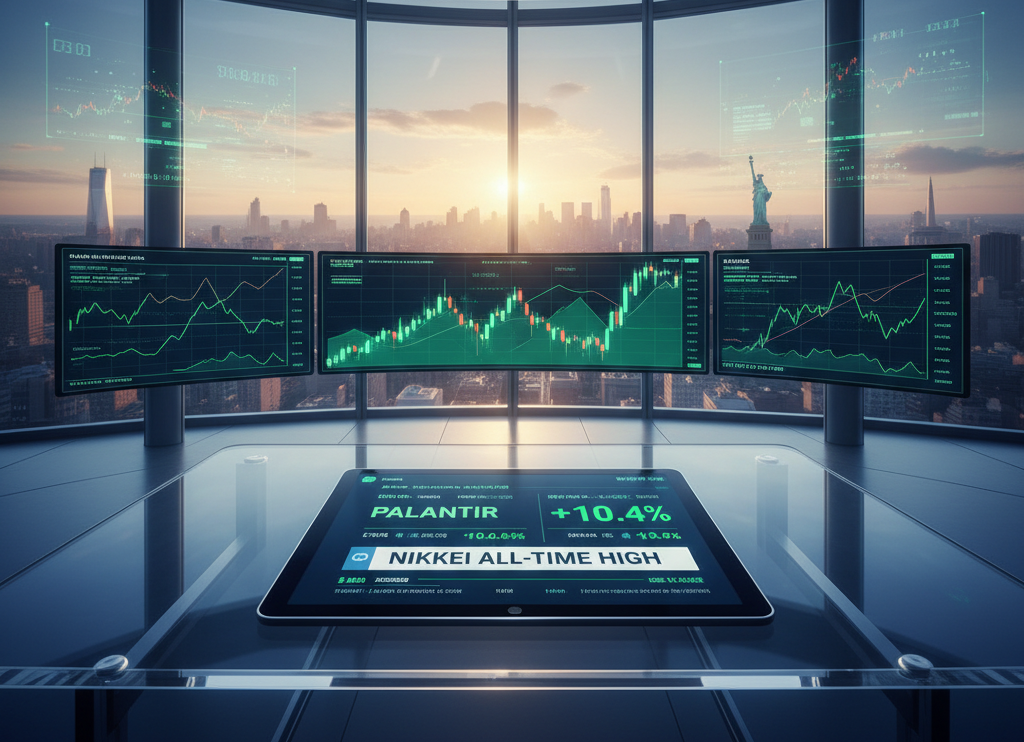
The Tuesday pre-market session is defined by a powerful “risk-on” rotation that has effectively neutralized the geopolitical jitters seen earlier this week. Following a historic overnight performance in Tokyo where the Nikkei 225 vaulted to a record high of 54,721, U.S. futures are indicating a robust opening for the Nasdaq and S&P 500. Traders are currently pivoting away from the “data blindness” caused by the ongoing partial U.S. government shutdown and focusing instead on a massive wave of corporate earnings that suggest the artificial intelligence trade is entering a more mature, revenue-generating phase.
The primary narrative this morning is the “AI Payback” phase. After a year of skepticism regarding whether massive capital expenditures would lead to bottom-line results, Palantir Technologies has provided a definitive answer. Its double-digit post-market surge yesterday is serving as a lighthouse for the broader software and defense sectors, while Teradyne’s bullish forecast confirms that the physical data center infrastructure build-out remains on a high-growth trajectory. This earnings strength is helping the market overlook the delay in the January jobs report, as private-sector indicators, such as the recent expansion in U.S. factory activity, serve as a proxy for economic resilience.
However, the session is not without its casualties. The dramatic plunge in PayPal shares highlights a “K-shaped” corporate reality where legacy fintech firms are struggling with execution even as pure-play AI assets soar. Investors are also keeping a close eye on the Treasury market as the yield on the 10-year note hovers near 4.17%. The recent nomination of Kevin Warsh to lead the Federal Reserve continues to spark debate over future interest rate trajectories, yet for this morning, the sheer momentum of corporate profits is the dominant force. Market participants should expect high volatility at the open as institutional rebalancing meets this fresh wave of retail optimism.
Pre-Market News Catalysts
- Palantir Technologies (PLTR): Shares jumped 10.4% in pre-market trading after reporting a fourth-quarter revenue beat of $1.41 billion and issuing a 2026 revenue guidance of $7.2 billion. The company’s Artificial Intelligence Platform (AIP) is seeing explosive adoption in the U.S. commercial sector, which grew by over 115% year over year.
- Teradyne Inc. (TER): The semiconductor testing giant surged 23.7% after forecasting first-quarter revenue between $1.15 billion and $1.25 billion, far exceeding the $966 million consensus. Management explicitly cited massive “AI-related compute demand” as the primary driver for the upbeat outlook.
- PayPal Holdings (PYPL): The stock plummeted 16.1% pre-market following a fourth-quarter earnings miss of $1.23 per share (versus $1.29 expected) and the announcement of Enrique Lores as the new CEO. A cautious Q1 outlook has raised concerns that the company’s turnaround is losing momentum.
- Mizuho Financial Group (MFG): U.S.-listed shares of the Japanese lender rose over 5% following its profit beat and an expanded share buyback program, riding the wave of the Nikkei’s record-breaking overnight session.
The Day’s Debate (The Bull vs. Bear Case)

The Bull Case: The optimistic interpretation of current market action is based on accelerating corporate earnings and broadening market participation. S&P 500 earnings growth is currently trending toward 12-15% for 2026, significantly outperforming the cautious estimates from late last year. Strategists like Ryan Detrick of Carson Group argue that the bull market is entering its fourth year with strong momentum, noting that historical cycles often see performance improve as leadership rotates away from narrow tech concentration into industrials, financials, and materials.
The record highs in Japan and South Korea overnight suggest a global “risk-on” appetite that is likely to push the S&P 500 toward 7,500. Furthermore, the “AI infrastructure harvest” is now visible in the balance sheets of companies such as Teradyne and Palantir, indicating that the tech cycle has moved beyond mere hype. Bulls believe that as long as the Federal Reserve continues its moderate easing cycle, even under new leadership, the combination of fiscal stimulus and productivity gains will keep the recessionary bears at bay.

The Bear Case: Pessimistic experts point to growing fragility masked by the “Magnificent Seven” and high-flying AI names. The bear case centers on the deepening “K-shaped” economy, where lower-income households are facing severe financial strain even as asset owners celebrate new records. This divergence is reflected in U.S. consumer confidence, which recently plunged to its lowest level since 2014. Analysts warn that the market is currently “data blind” due to the government shutdown, creating a dangerous environment where the Federal Reserve could make a significant policy error.
Additionally, the nomination of Kevin Warsh has introduced a “tighter-policy undertone” that has already caused massive volatility in precious metals and could soon spill into equities if yields move higher. Bears argue that current valuations—with the S&P 500 trading at historically high multiples—leave no room for earnings disappointments. They view the 16% decline in PayPal’s stock price as a warning sign that consumer demand is weakening and that the “AI halo effect” cannot shield the entire market from the reality of high interest rates and persistent service-sector inflation.
The Strategic Takeaway
The most critical factor for today’s session is whether the market can sustain the “earnings-driven” rally amid significant macroeconomic uncertainty. While the Palantir and Teradyne results are undeniably strong, they represent a specific high-growth niche. The real test for the opening bell will be the breadth of the rally.
If the Dow Jones Industrial Average can stay positive despite the drag from PayPal and other consumer-facing stocks, it would signal a healthy rotation. However, if the gains remain concentrated solely in AI-linked semiconductors and software, the market remains vulnerable to a “sharp reversal” if tomorrow’s private labor data surprises to the upside. Investors should maintain a neutral-to-long bias but tighten stop-losses on high-multiple tech names. The 7,000 level on the S&P 500 remains the key psychological battleground. A decisive hold above this mark today would likely trigger a wave of FOMO (fear of missing out) that could drive the market to new all-time highs by the end of the week.
Upcoming Session Outlook with Directional Bias
The pre-market data suggests a Bullish tone for the market open, as the combination of record-breaking international sentiment and standout AI earnings provides enough “upward thrust” to overcome the localized weakness in the fintech sector and the ongoing lack of official government economic data.
Disclaimer: This article is for informational purposes only and does not constitute financial, investment, or legal advice. The information provided is a synthesis of publicly available data and expert analysis and should not be considered a recommendation to buy or sell any security. Investing in the stock market involves risk, including the possible loss of principal. Past performance is not indicative of future results. Readers should consult with a qualified financial advisor to determine an investment strategy that is suitable for their own personal financial situation and risk tolerance.
Sources
- Investing.com: S&P, Nasdaq futures rise as earnings deluge takes center stage
- The Motley Fool: Why Shares of Palantir Are Soaring
- Seeking Alpha: Biggest stock movers Tuesday: PLTR, TER, and more
- The Japan Times: Nikkei reaches new high as earnings fuel rebound
- Investing.com: PayPal names Enrique Lores as CEO; Shares tumble
- Morgan Stanley: 2026 Stock Market Outlook
- BNN Bloomberg: Ryan Detrick on the 2026 Bull Case