



Morning Market Snapshot – Monday, March 9
Traders are staring down the worst pre-market setup since the conflict with Iran began ten days ago.
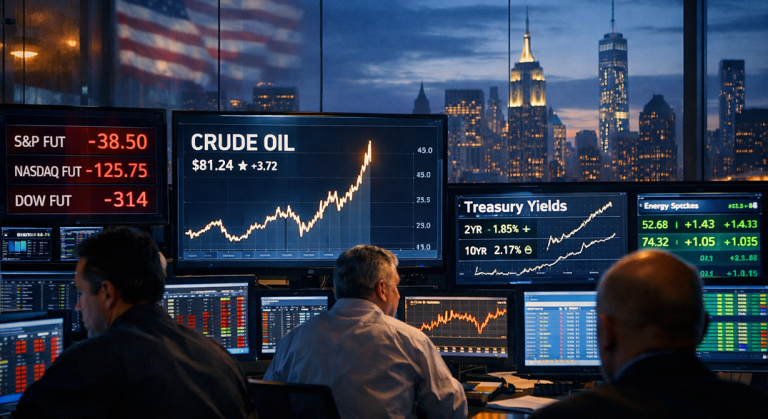
U.S. stock futures are deep in the red as oil prices blow past $107 per barrel and the Iran war enters its second week with no end in sight. Futures tied to the Dow Jones Industrial Average dropped by around 2.1%, or more than 1,000 points. Contracts linked to the S&P 500 fell 2%, while Nasdaq 100 futures declined roughly 2.3%.
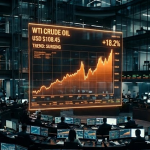
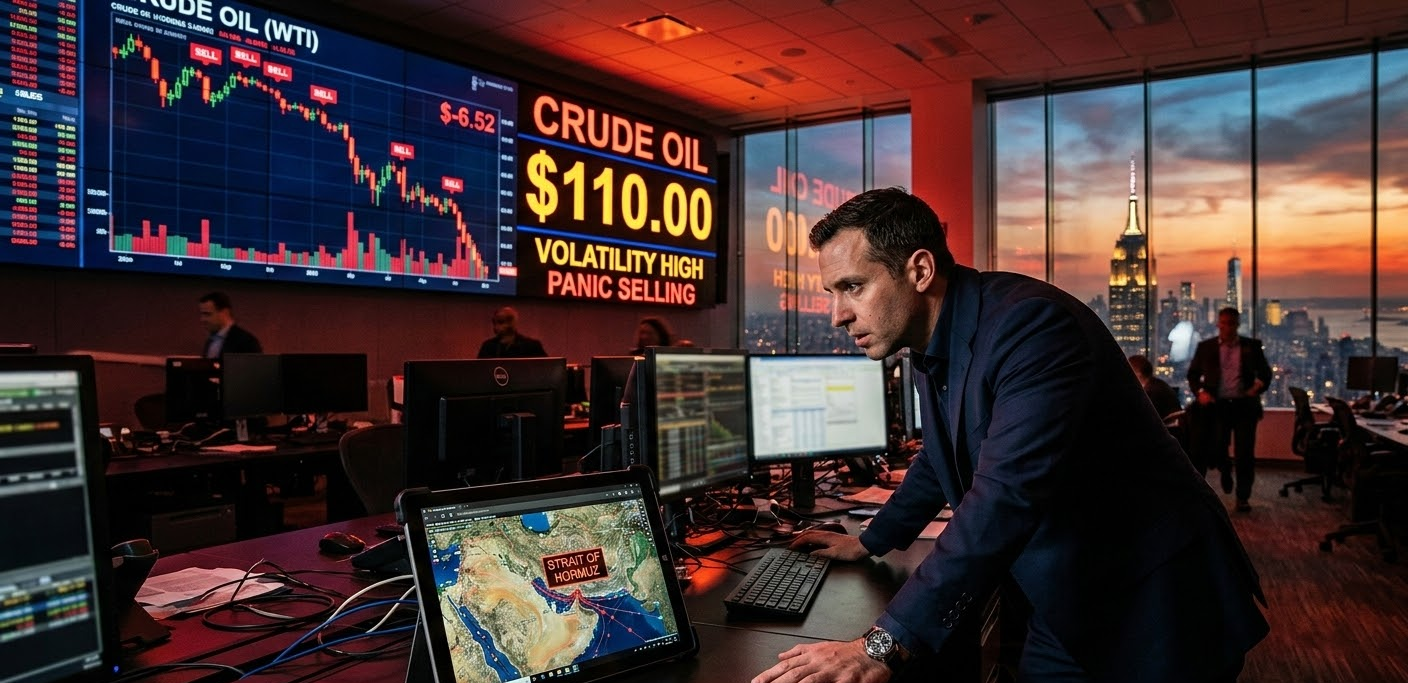
The proximate cause is oil, and oil alone. Disrupted shipping in the Strait of Hormuz and output cuts by major Middle Eastern oil producers sent WTI crude futures surging as much as 22%, surpassing $110. Brent crude futures jumped 20% to $111.04 per barrel. Energy markets were pushed higher after Kuwait confirmed production cuts, while output in Iraq plunged approximately 70% as available storage nears capacity.
The damage overseas has been severe. South Korea’s Kospi triggered its second circuit breaker in four sessions on Monday, leading a broader regional sell-off as oil prices neared $120 per barrel for the first time since 2022. The index plunged by more than 8%, triggering a 20-minute suspension of trading. Japan’s Nikkei 225 fell by around 5.2% on Monday, while Vietnam’s VN-Index dropped around 5.7%. Hong Kong’s Hang Seng Index fell by around 1.8%, and India’s NIFTY 50 is down 2.5%. Among Asian markets, China’s SSE Composite was in the best shape, down just 0.78%.
There was a brief glimmer of relief when Saudi Arabia reportedly offered roughly 4.6 million barrels via a pipeline to Yanbu on the Red Sea, easing oil prices modestly from their highs. Asia-Pacific markets moderated losses following the news, though oil prices remain well above $100 per barrel.
For U.S. traders, the stagflation narrative has never been louder. The February jobs report showed nonfarm payrolls fell by 92,000, sharply missing expectations of 55,000 jobs added, and the unemployment rate rose to 4.4%. A slowing labor market combined with rising oil prices has raised fears of stagflation, a toxic combination of weak growth and rising inflation. The 10-year Treasury yield rose three basis points to 4.17%, while the dollar hit its highest level since January.
The week ahead carries its own weight. Investors will be watching closely for Wednesday’s Consumer Price Index and Friday’s Personal Consumption Expenditures index readings, though neither yet captures the full effect of oil’s dramatic recent surge. Earnings from Hewlett Packard Enterprise are expected after Monday’s closing bell, with Oracle, Adobe, and Dick’s Sporting Goods scheduled later in the week. The Federal Reserve meets March 17-18. With stagflation fears now the dominant macro narrative, traders are not expecting rate relief.
Pre-Market News Catalysts
- Target (TGT): Earnings Due This Morning. Target is in focus today as it reports earnings, providing a window into the health of the U.S. consumer amidst rising prices. With consumer spending under pressure from surging energy costs and a weakening labor market, the report is expected to give markets a real-time read on whether the American shopper is still holding up.
- Microsoft (MSFT): A Rare Pre-Market Bright Spot. Microsoft has emerged as a leader in a “software rotation,” with shares seeing relief after a significant backlog update. The company reported that its remaining performance obligations jumped to $625 billion, signaling robust long-term demand for its AI-integrated cloud services. With a consensus Buy rating from 31 analysts and a price target of $595.90, MSFT is being cited by strategists as one of the safest places to shelter in the current tape.
- Alphabet (GOOGL): Slipping Below Key Support. Alphabet saw its stock slip below the $300 support level amid concerns over its massive $175 billion to $185 billion capital expenditure guidance for 2026. A break below $300 that holds at the open would be a technically significant development and could accelerate selling across the broader Magnificent Seven complex.
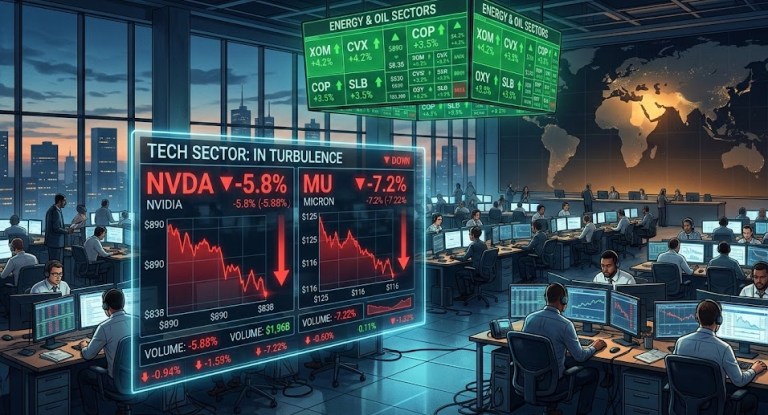
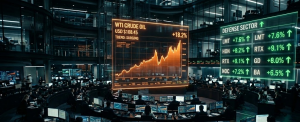
- Energy Sector (XOM, CVX, OXY): The Only Green on the Board. Energy is up more than 25% on the year, more than double materials, which is in second place at up 10%. Defense stocks have also rallied sharply since the strikes on Iran began, with Lockheed Martin and Northrop Grumman both surging. Every other sector is under pressure as markets reprice a prolonged Middle East conflict with no clear resolution date.
The Day’s Debate – Bull Versus Bear case

The Bull Case: The optimists acknowledge the pain but argue it is survivable, and that history is on their side. Goldman Sachs analysts have urged investors to view the KOSPI’s dramatic decline in context, writing in a March 6 report that they “view the pullback as a correction that will likely be followed by a recovery to new highs after a period of consolidation.” Eli Lee, chief investment strategist at Bank of Singapore, echoed the point: “We expected a knee-jerk risk-off market reaction. But barring an oil shock, history shows that geopolitical events typically do not negatively impact equity prices on a prolonged basis.”
Bulls point to Microsoft’s $625 billion remaining performance obligations as proof that the AI infrastructure buildout remains intact beneath the geopolitical noise. They also note that Asia-Pacific markets moderated losses after Saudi Arabia’s pipeline offer eased some supply pressure, interpreting that as evidence that the oil market remains responsive to intervention. The S&P 500 is now testing the 6,665-6,740 range, and analysts at CastleMoore note they are watching for a washout event where weak hands are shaken loose, creating the reset needed to ramp up risk exposure again at more favorable levels, consistent with the seasonal strength typical of late March and April. For dip buyers, that washout may be arriving this morning.

The Bear Case: Pessimists argue that this is structurally different from past geopolitical shocks and that the market has not yet fully priced in the damage. FXStreet’s Asia desk put it plainly: “When oil rises to $110, the market does not haggle over valuation models. It heads straight for the nearest exit.” Japan and Korea are giant industrial engines that run on imported oil. When crude spikes, it moves straight through the corporate bloodstream. Input costs surge, inflation expectations climb, and earnings estimates get marked down faster than analysts can rewrite their notes. It is the macro equivalent of watching a tax get imposed on the entire economy overnight. The numbers support the concern.
Wolfe Research’s Stephanie Roth highlighted that a $20 hike in oil prices could mean a 0.1% hit to U.S. GDP and a 0.4% jump in headline inflation. US stock futures sank more than 1.5% on Sunday as investor concerns over the impact of the Middle Eastern conflict on the world economy deepened after oil prices surged above $100 per barrel. Several Middle Eastern countries, including Kuwait, Iran, and the UAE, have reduced crude output as available storage capacity runs out.
The Fed is trapped. Cut rates into $110 oil, and you pour fuel on an inflationary fire. Hold rates in a jobs market that just printed -92,000, and you risk tipping a weakening economy into recession. There is no clean exit.
The Strategic Takeaway
The single most important thing to carry into today’s open is this: the oil market is now the Fed, the economic data, and the earnings season all rolled into one. Nothing else matters until traders get a credible signal that Strait of Hormuz shipping will resume or that a ceasefire framework is on the table.
A sustained violation of horizontal support around 6,800 on the S&P 500, resolving an approximately 200-point range from the last few months, proposes a downside target of 6,600. With futures pointing to an open well below that level, the 6,600 zone becomes the first line in the sand for anyone considering adding exposure.
Defensively, the playbook remains energy, defense, and select software names with durable AI revenue. Offensively, the risk is that this morning’s open produces a washout that triggers the dip-buying cycle bulls are waiting for. But catching that falling knife requires patience, position sizing, and a clear stop. Watch the first 30 minutes closely. The tape will tell you whether today is a capitulation event or just another step down in an ongoing repricing.
Upcoming Session Outlook with Directional Bias
Directional Bias: Bearish
Dow Jones futures dropped more than 860 points, or 1.82%, while S&P 500 futures fell 1.61%, and Nasdaq 100 futures slid nearly 2% as the trading day began. Just after 1 a.m. At ET, the S&P 500 fell nearly 2%. Impacts are likely to be a little more measured across Europe in the morning hours, offering some hope for U.S. indexes, which have been facing some pretty stark declines in futures trading.
Any relief will be news-driven, not data-driven. Target’s earnings print this morning, CPI on Wednesday, and any headline out of the Middle East are the three catalysts capable of changing the direction of the tape. Until one of those moves the needle, the path of least resistance is lower.
Disclaimer: This article is for informational purposes only and does not constitute financial, investment, or legal advice. The information provided is a synthesis of publicly available data and expert analysis and should not be considered a recommendation to buy or sell any security. Investing in the stock market involves risk, including the possible loss of principal. Past performance is not indicative of future results. Readers should consult with a qualified financial advisor to determine an investment strategy that is suitable for their own personal financial situation and risk tolerance.
Sources
- Stock Market Today: Live updates, top news for March 9, 2026 – TheStreet
- Oil Surge and Geopolitical Tensions Send Markets Reeling; Tech Resilience in Focus – Market Updates
- Stock Market Today: Dow, S&P Live Updates for March 9 – Bloomberg
- KOSPI Plunges 8%, Circuit Breakers Triggered Amidst Geopolitical Shock | Whalesbook
- Oil worries and Iran war hammer Asian stocks, with Korea’s KOSPI taking the biggest hit | Fortune
- Market Intelligence | S&P Global