




Morning Market Snapshot – Monday, March 16
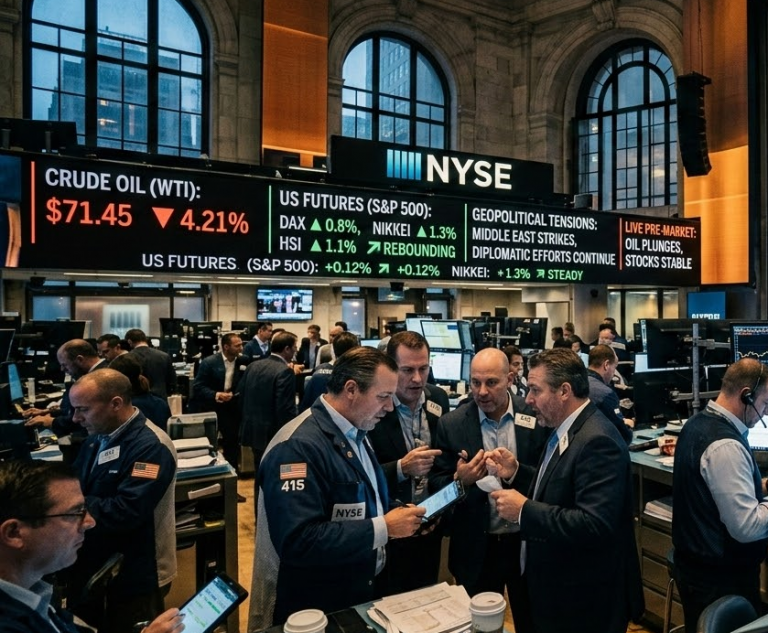
The overnight market tone was cautious, not panicked. U.S. index futures turned higher into the morning, with Dow futures up 0.19%, S&P 500 futures up 0.41%, and Nasdaq 100 futures up 0.51% in early trading. That rebound came even as Brent crude traded at about $106.30 a barrel, with oil still elevated because the Strait of Hormuz remains mostly shut and the weekend attack on Iran’s Kharg Island kept supply fears front and center. In Europe, the STOXX 600 was flat, while Asia-Pacific stocks edged up 0.3%, helped by a rebound in South Korea. Chinese retail sales and industrial output also topped forecasts, which offered a modest counterweight to the energy shock.
What matters most before the open is that traders are treating oil as the master variable. The rise in crude has sharply changed rate expectations ahead of this week’s central-bank meetings. Reuters reported that traders are no longer fully pricing even one Fed cut this year, and the chance of a June easing has fallen to 26% from 69% a month ago. Ten-year Treasury yields were around 4.265%, after rising sharply since the conflict began. In other words, the market is no longer debating only growth. It is debated whether an oil shock creates sticky inflation, slower growth, or both.
That is why the green futures tape needs to be read carefully. The bullish side is that U.S. equities have held up better than many global peers, partly because beaten-down tech is bouncing and partly because the U.S. is a net energy exporter. The cautious side is that this resilience is narrow and fragile. Reuters noted the VIX slipped to 26.31, indicating some reduction in immediate fear, but it remains elevated enough to suggest risk appetite remains conditional. This morning’s setup is therefore constructive at the index level, but still highly sensitive to every move in crude, yields, and any signal from policymakers.
Pre-Market News Catalysts
- Meta Platforms (META): Shares rose about 3% in premarket trading after Reuters reported the company was preparing sweeping AI-related layoffs to offset large infrastructure spending and improve efficiency.
- Micron Technology (MU): The stock gained roughly 4% after an RBC price-target hike, with AI and memory demand also keeping the name in focus ahead of results this week.
- Nvidia (NVDA): Nvidia traded higher ahead of its annual developer conference, with investors seeking fresh evidence that AI spending remains durable even amid a tougher macro backdrop.
- Tesla (TSLA): Tesla added about 1% after Elon Musk said the company’s Terafab AI chipmaking project would launch within seven days.
The Day’s Debate (The Bull vs. Bear Case)

The Bull Case: The optimistic read is that the market is starting to treat the oil shock as severe but temporary. Reuters reported that many analysts’ base case still assumes a short-lived conflict and eventually lower oil prices, and U.S. Energy Secretary Chris Wright said he expects the conflict to end within weeks, followed by a rebound in supply and lower prices. That matters because if crude stabilizes rather than accelerates, the overnight rebound in futures starts to make sense: U.S. stocks have already shown relative strength versus Europe and Asia, the U.S. benefits more than other major economies from being a net energy exporter, and leadership is rotating back into AI-linked megacaps rather than disappearing altogether.
Add in better-than-expected Chinese activity data, and you have the outline of a market trying to look through the shock rather than price a full-blown demand collapse. The more constructive interpretation is not that risk has vanished. It is that traders think the worst-case supply scenario still is not the base case, and that central banks, including the Fed, may stay watchful without reacting aggressively to the first inflation impulse from oil.

The Bear Case: The pessimistic interpretation is more straightforward and, this morning, arguably more fundamental. Reuters reported that a fifth of global oil supply has effectively been stranded by the conflict, crude has jumped almost 50% in two weeks, and U.S. gasoline prices have risen nearly 25% over that span. At the same time, February core PCE inflation was running at 3.1%, and fourth-quarter U.S. GDP growth was revised down to 0.7%. That is an ugly combination before the oil shock is even fully reflected in the data.
Societe Generale’s Kenneth Broux framed the core fear clearly: either policymakers need restrictive policy to stop second-round inflation effects, or economies slide toward recession and risk assets reprice lower. Deutsche Bank’s Matthew Luzzetti also wrote that a Fed hike in 2026, once nearly unthinkable, is now at least being discussed again. This is the bear argument in one sentence: equities are trying to rally, while the bond market warns that the inflation-growth mix is deteriorating. If crude stays near or above $100, the morning bounce in futures may prove to be little more than a tactical rebound inside a broader repricing of earnings, margins, and policy expectations.
The Strategic Takeaway
The single most important thing to keep in mind as the opening bell approaches is that the overnight lift in futures is not the story by itself. The real story is whether oil stops climbing. If crude cools, tech strength and relative U.S. resilience can carry the tape higher for a session. If crude pushes higher again, the market is likely to return to pricing in inflation persistence, fewer rate cuts, and tighter financial conditions. My synthesis is that traders should watch energy first, then Treasury yields, and only then the futures board. A positive premarket print is helpful, but it is not yet a clean signal that the macro pressure has passed.
Upcoming Session Outlook with Directional Bias
The expected tone of the open looks Slightly Bullish, but fragile, because index futures are positive and tech leadership is helping, yet the entire setup still rests on whether oil remains contained and whether yields stay orderly as the Fed meeting approaches.
Disclaimer: This article is for informational purposes only and does not constitute financial, investment, or legal advice. The information provided is a synthesis of publicly available data and expert analysis and should not be considered a recommendation to buy or sell any security. Investing in the stock market involves risk, including the possible loss of principal. Past performance is not indicative of future results. Readers should consult with a qualified financial advisor to determine an investment strategy that is suitable for their own personal financial situation and risk tolerance.
Sources
- Fed to present an updated outlook looking through the fog of war | Reuters
- Stock markets cautious, oil gains on Hormuz doubts; traders await central banks | Reuters
- Nebius, Meta, Micron, Sandisk, Nvidia, Dollar Tree, Strategy, and More Stock Market Movers – Barron’s
- U.S. stock futures, oil prices bounce around as investors weigh developments in Iran conflict – MarketWatch