



Morning Market Snapshot – March 23, 2026
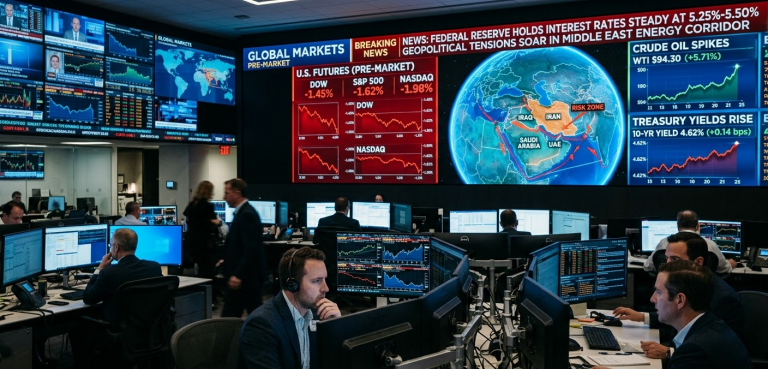
Overnight trading broke into two acts. First came a hard risk-off move. Asia sold off sharply as the Iran-Hormuz crisis kept energy supply fears front and center: Japan’s Nikkei fell 3.5%, South Korea’s KOSPI dropped 6.49%, India’s Nifty 50 fell 2.6%, and the rupee hit a record low at 93.98 per dollar. At the same time, Brent crude climbed to about $113.20, and WTI pushed above $100, while the U.S. 10-year Treasury yield hit roughly 4.43% as traders priced out rate cuts and began talking again about possible hikes.
Europe initially followed that script, with the STOXX 600 sliding 2.2% to 561.11, enough to confirm a correction. Gold did not provide much shelter either, falling 4.9% to $4,266.47 after touching $4,097.99, its ninth straight daily loss.
Then the tape flipped. Reuters reported that President Trump said the U.S. would postpone military strikes on Iranian power plants and energy infrastructure for five days after what he called good and productive conversations with Iran. That triggered a relief move across assets. Dow E-minis jumped 1,246 points, or 2.72%; S&P 500 E-minis rose 2.39%; Nasdaq 100 E-minis gained 2.03%. Oil reversed violently, with Brent falling about 15% to a session low near $96 and WTI dropping about 13.5% to $85.28. Europe’s STOXX 600 erased losses and turned positive, while the dollar gave back its haven bid and the euro climbed above $1.15. Bitcoin also rebounded, rising as much as 4.8% to around $70,800.
What traders should focus on now is durability, not drama. The relief bid says the market had become deeply positioned for a worse escalation path. But the underlying inflation problem has not disappeared. Bloomberg reported that global bond yields had already climbed to their highest levels since May 2024 on fears that energy costs could force central banks back toward tightening, and Bloomberg also cited the IEA, saying more than 40 Middle East energy assets across nine countries have been severely or very severely damaged.
Add in Japan’s 5.26% wage increase, which keeps the Bank of Japan’s normalization alive, and the opening setup is clear: the market is trying to rally, but the macro pressure from energy and rates remains very real.
Pre-Market News Catalysts
- United Airlines (UAL): United shares were reported lower in Monday’s premarket after the carrier said it would cut additional unprofitable flights amid soaring fuel costs that are squeezing margins.
- Delta Air Lines (DAL): Delta was indicated down 1.77% in premarket at $62.32, a sympathy move tied to the same airline fuel-cost pressure that hit United.
- American Airlines (AAL): American was down 1.05% in premarket at $10.32, also reflecting the pressure higher jet-fuel costs are putting on the airline group.
- Lockheed Martin (LMT): Lockheed was down about 0.9% in premarket at $621.79. That appears to be a partial unwind of the geopolitical-risk trade after the five-day strike postponement, rather than company-specific news.
The Day’s Debate (The Bull vs. Bear Case)

The Bull Case: The optimistic read is that markets finally found an off-ramp. The overnight reversal was not subtle: oil cracked, futures ripped higher, Europe stabilized, bonds bounced, and even crypto joined the relief move. Reuters’ market roundup showed that strategists at Société Générale, IG, and Brown Brothers Harriman all treated the pause as meaningful enough to warrant an unwind in the fear trade, especially if it develops into genuine de-escalation.
Bloomberg’s survey of strategists also showed that many still expect European equities to recover to record highs by year-end, treating the war-driven oil spike as temporary rather than structurally growth-destroying. In that framework, the opening bell becomes less about a collapsing macro regime and more about a market that had become too defensively positioned, too quickly. If oil can stay well off the overnight highs, the most immediate inflation shock would soften, easing pressure on yields and high-duration assets.

The Bear Case: The pessimistic view is that this is only a pause, and markets are vulnerable to relearning the same lesson within hours. Reuters’ instant view made that point directly: strategists saw relief, but not resolution. Bloomberg reported that global bond yields have already surged to their highest levels since May 2024 because energy inflation is reviving rate-hike fears, and the IEA’s warning about more than 40 severely damaged energy assets suggests the supply shock may outlast the headlines.
Reuters also reported that Goldman Sachs raised its 2026 Brent forecast to $85 and sees a risk case as high as $135 if disruptions persist, while another Reuters report said hedge funds added to bearish bets against U.S. stocks. In other words, even if the opening pop holds, the market still faces the same underlying problem: damaged infrastructure, sticky energy inflation, tighter financial conditions, and a central-bank path that looks less friendly than it did a few weeks ago.
The Strategic Takeaway
The most important thing to keep in mind into the open is that the real market driver is no longer just war headlines, it is the expected duration of the energy shock. Overnight price action proved that a de-escalation headline can reverse oil, futures, currencies, and crypto in minutes. But the structural backdrop remains fragile because damaged energy infrastructure, higher wage pressure in Japan, and revived rate-hike speculation all argue that inflation risk can outlive any single diplomatic pause. Traders should think in layers: headline relief can lift the open, but unless oil stays contained and yields stop climbing, cyclicals, airlines, and long-duration tech can all come back under pressure quickly.
Upcoming Session Outlook with Directional Bias
Directional bias: Slightly Bullish. As of 7:44 a.m. EDT, the balance of overnight evidence favors a firmer U.S. cash open because stock futures, Bitcoin, European equities, and bonds all improved after the five-day strike delay, but conviction should stay low because the same Reuters strategists framing the rebound also described it as a pause, not a settlement.
Disclaimer: This article is for informational purposes only and does not constitute financial, investment, or legal advice. The information provided is a synthesis of publicly available data and expert analysis and should not be considered a recommendation to buy or sell any security. Investing in the stock market involves risk, including the possible loss of principal. Past performance is not indicative of future results. Readers should consult with a qualified financial advisor to determine an investment strategy that is suitable for their own personal financial situation and risk tolerance.
Sources
- US stock futures jump 2% after Trump postpones strikes on Iranian power plants | Reuters
- World markets reverse course, stocks rally as Trump postpones Iran military strikes | Reuters
- Instant view: World markets rally as Trump postpones military strikes on Iranian power plants | Reuters
- Global Bond Yields Climb as Iran War Upends Rate Expectations | (Bloomberg)
- Over 40 Middle East Energy Assets ‘Severely Damaged,’ IEA Says | (Bloomberg)
- United shares slip as airline cuts flights on soaring fuel costs
- MarketWatch quote pages for DAL, AAL, and LMT premarket indications | (MarketWatch)