
Morning Market Snapshot – January 20, 2026
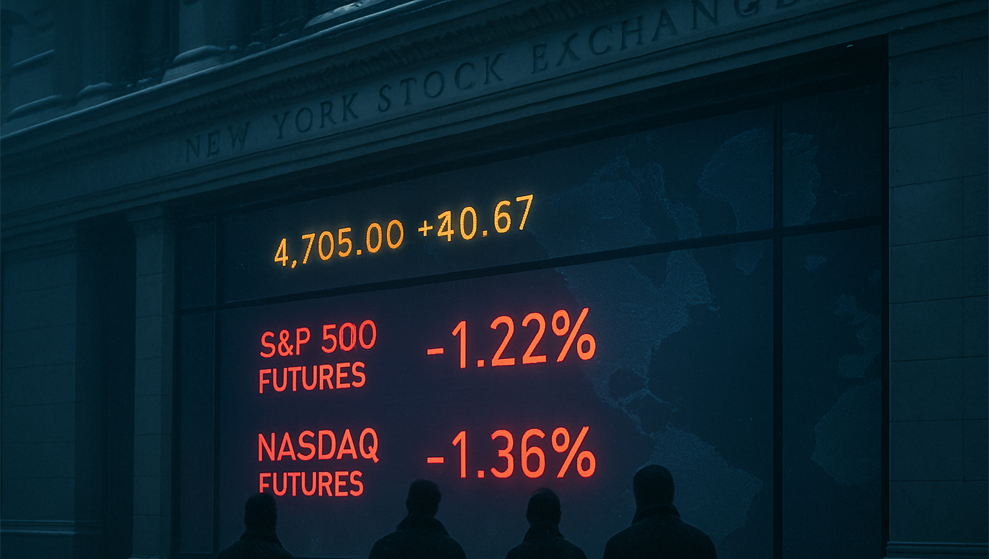
Overnight markets moved into a classic risk-off posture as investors repriced geopolitical and trade risk tied to President Donald Trump’s renewed tariff threats against Europe, explicitly linked to a push to acquire Greenland. By early Tuesday, U.S. index futures were sharply lower, with S&P 500 e-minis down 1.61%, Nasdaq 100 e-minis down 1.97%, and Dow e-minis down 1.47% (as of 5:32 a.m. ET). Volatility followed, with the VIX touching a two-month high at 20.61.
The overnight message from cross-asset markets was consistent: investors wanted less U.S. and less risk exposure, at least until there is clarity on whether this is brinkmanship or policy. A widely shared focus is whether diplomacy can quickly cool the temperature. As AJ Bell’s Russ Mould put it, markets will be looking for “some sort of de-escalation deal,” warning that a deepening crisis is “unlikely to spell good news for global equities.”
Safe havens did the heavy lifting. Gold pushed decisively into new territory, with spot gold up around 1.2% to $4,726.86/oz, after printing an all-time high of $4,737.10, while U.S. gold futures also surged. UBS analyst Giovanni Staunovo framed the move as fundamentally tied to growth concerns stemming from tariff threats and expectations of lower U.S. rates, and he reiterated a $5,000/oz target.
In FX, the dollar weakened as traders paid up for protection against early-February swings in the euro, a tangible sign that hedging demand is rising, not fading. In commodities, oil firmed modestly, helped by a softer dollar and attention shifting to China’s stronger-than-expected data backdrop. Brent was around $64.09 and WTI (Feb) around $59.58 in early pricing, with headlines also flagging China’s demand signals and broader geopolitical noise.
Outside the U.S., Europe took the hit first, with the STOXX 600 sliding as tariff anxiety resurfaced and luxury names came under pressure amid new headline risks. In Japan, a separate stress point emerged: a sharp selloff in super-long JGBs after election-related fiscal promises raised fears of a regime shift in the long end of the curve.
The trader’s task into the open is straightforward: separate a durable signal from headline volatility. Watch for any sign of de-escalation, watch rates for disorderly moves, and watch whether earnings can regain the microphone from geopolitics.
Pre-Market News Catalysts
- RAPT Therapeutics (RAPT): Up about 63.5% premarket after GSK agreed to buy RAPT for $2.2B, paying $58/share.
- Hecla Mining (HL): Up about 6.3% premarket as gold surged past $4,700/oz and investors rotated into precious-metals leverage.
- Endeavour Silver (EXK): Up about 4.8% premarket alongside the broader precious-metals rally.
- Netflix (NFLX): Up about 0.6% premarket ahead of results expected after the close, a rare single-stock offset to the broader risk-off tape.
The Day’s Debate (The Bull vs. Bear Case)

The Bull Case: The optimistic view starts with a familiar market pattern: sharp, headline-driven risk-off moves often fade when policymakers signal flexibility. The key bull assumption is that the Greenland-linked tariff threat is primarily leverage, and that the market is pricing a worst-case path faster than it will actually unfold. Even within the Reuters framing, investors are explicitly “hoping for… de-escalation,” which is shorthand for a negotiated off-ramp that preserves NATO cohesion and reduces the probability of sustained trade friction.
Bulls also point to the idea that safe-haven demand can stabilize financial conditions rather than break them. Gold’s surge is dramatic, but the logic is coherent: when policy uncertainty rises, capital seeks store-of-value assets. UBS’s Staunovo attributes the move to growth concerns plus the market’s expectation that lower rates would be supportive for non-yielding assets, and he still sees upside. That matters because it implies the market’s “fear trade” is not purely panic; it is a reallocation into hedges.
Another support is macro resilience outside the tariff headlines. China reported full-year growth that hit its 5% target, and Beijing is also signaling longer-term measures to spur consumption and tilt support toward services, extending some subsidies through 2026. Oil’s steadier tone also fits a view that global demand expectations are not collapsing, helped by the weaker dollar and China-linked optimism.
Finally, bulls argue that the calendar can quickly reassert fundamentals. U.S. traders are returning from a long weekend into a busy stretch of data, earnings, and global leadership appearances, including Davos, which can become a venue for cooling rhetoric. If earnings narratives dominate, especially in mega-cap and AI-adjacent areas, positioning could snap back faster than headline readers expect.

The Bear Case: The bearish case is that this is not a normal tariff squall. The structure of the threat matters: tariffs beginning February 1, escalating to 25% by June 1 if no deal is reached, explicitly tied to sovereignty over Greenland. That is not a conventional trade negotiation frame, and it raises the risk of tit-for-tat retaliation and prolonged uncertainty. Russ Mould’s warning about a potential NATO rupture captures what bears fear most: a geopolitical shock that keeps risk premia elevated.
Markets are also showing signs of “Sell America” behavior across assets. The dollar’s weakness is not just a currency story; it is a confidence story, and Reuters notes demand for euro hedges rising sharply into early February. When investors start paying up for protection, liquidity can thin out, and price moves can overshoot. Add the equity selloff in futures and the jump in volatility, and you have the conditions for tighter financial conditions in a hurry.
Rates are a second pressure point. Reuters’ Morning Bid described the 10-year U.S. Treasury yield rising to about 4.265%, a four-month high, even as the dollar weakened, an uncomfortable combination that suggests foreign-policy risk can weigh on both currency and bonds at the same time. (Reuters) If yields rise because risk premia rise, equities can struggle to find a floor.
Japan adds a separate, credible stress signal. A sharp repricing in the super-long JGB sector, tied to election-driven fiscal promises, pushed 20-year yields above 3.4% and drove large two-day jumps across the long end. Maybank’s Tareck Horchani described it as a “regime-style repricing,” and Fidelity’s Ian Samson questioned who the natural buyer is when inflation is above target and anchors look weak. Bears do not need Japan to “break” to worry, they just need global duration markets to stay unstable.
In that world, today’s open is less about dip-buying and more about whether markets can avoid a second wave of de-risking once cash equities are fully active again.
The Strategic Takeaway
Treat this morning as a policy-risk tape, not a pure earnings tape. The most investable information will come from whether rhetoric moves toward an off-ramp, or hardens toward escalation. In practical terms, the market is already telling you what it fears: volatility is higher, futures are lower, and hedging demand is rising.
If you trade or allocate intraday, anchor on three real-time checks:
- Any sign of de-escalation tied to the Greenland tariff framework, because it is the largest marginal driver of risk appetite right now.
- The behavior of yields, especially if higher yields coincide with a weaker dollar, can pressure equities more than either move alone.
- Gold and volatility, because they are the clearest scoreboards for fear. Gold’s move is extreme, and UBS is explicitly attributing it to tariff-driven growth worries and rate expectations.
In short, stay nimble. Let policy signals, not opinions, set your risk budget today.
Upcoming Session Outlook with Directional Bias
Directional bias for the open: Slightly Bearish. Futures were down sharply into the morning, volatility rose to a two-month high, and safe-haven flows pushed gold to new records, all consistent with risk reduction rather than bargain hunting at the open.
Disclaimer: This article is for informational purposes only and does not constitute financial, investment, or legal advice. The information provided is a synthesis of publicly available data and expert analysis and should not be considered a recommendation to buy or sell any security. Investing in the stock market involves risk, including the possible loss of principal. Past performance is not indicative of future results. Readers should consult with a qualified financial advisor to determine an investment strategy that is suitable for their own personal financial situation and risk tolerance.
Sources
- S&P, Nasdaq futures slide to one-month lows on Greenland concerns | Reuters
- Gold blazes trail beyond $4,700/oz to record high as safety rush fuels demand | Reuters
- Buyers flee Japanese debt as Takaichi hits the ground spending | Reuters
- European shares slide further as Trump’s tariff threat persists | Reuters