



Morning Market Snapshot – Friday, March 6, 2026
Overnight trading was dominated by one theme: a fast-rising geopolitical risk premium in energy. By early Friday, U.S. stock futures were lower as the war involving Iran continued to disrupt oil flows and force investors to reprice inflation, rates, and growth expectations. Reuters reported that at 5:14 a.m. ET, Dow E-minis were down 130 points, or 0.27%, S&P 500 E-minis were down 23 points, or 0.34%, and Nasdaq 100 E-minis were down 102.5 points, or 0.41%. Reuters also separately reported that S&P 500 and Nasdaq futures were down 0.29% and 0.38%, respectively, in European trading.
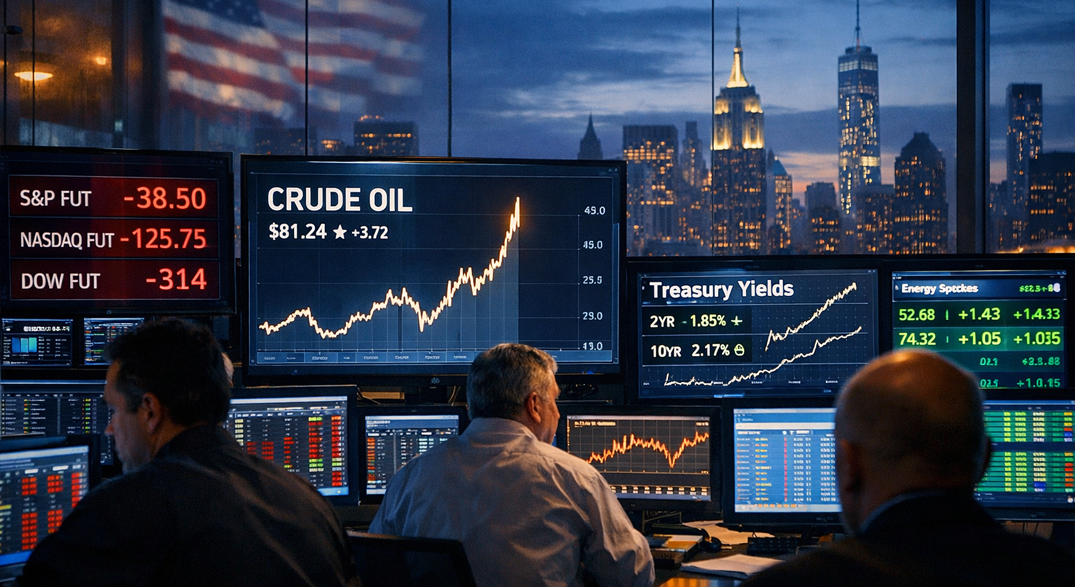
The pressure is coming from crude. Reuters said U.S. crude rose to $84.90, its highest level since April 2024, while Brent touched $87.66, its highest since July 2024. Brent was on track for a roughly 20% weekly jump, and Reuters noted elsewhere that Brent was up nearly 22% on the week while WTI was up almost 27%, marking the sharpest weekly gains since 2020. The core fear is that a disruption in the Strait of Hormuz could keep supply constrained long enough to reignite inflation, just as investors had been leaning toward easier monetary policy later this year.
Rates markets adjusted quickly. Reuters reported that traders now price only about 35 basis points of Federal Reserve cuts this year, down from around 55 basis points a week ago. The U.S. 10-year Treasury yield was last around 4.17%, on pace for its largest weekly rise since April 2025. Reuters also said the broader bond market is ending the week “battered and bruised” as investors contemplate the risk that central banks may need to tighten again if the energy shock persists. Berenberg chief economist Holger Schmieding told Reuters that the conflict has already undermined the assumption that energy prices would remain low and stable this year.
That is the setup for the U.S. session: equities are dealing with higher oil, firmer yields, and a stronger dollar, while traders also wait for the labor-market data due later this morning. Still, the overnight tape was not a full panic. Reuters noted that U.S. stocks have held up better than many Asian and European peers this week, helped by a 1.5% rebound in technology shares from February losses, and said the Nasdaq was still tracking for a small weekly gain. That leaves the market open, vulnerable, but not broken.
Pre-Market News Catalysts
- Marvell Technology (MRVL) jumped about 12% in pre-market trading after forecasting fiscal 2028 revenue of nearly $15 billion, above the analyst consensus of $12.92 billion, reinforcing the view that AI and data-center spending remains robust.
- Gap (GAP) fell about 5.9% after warning that tariffs would pressure results and forecasting annual adjusted profit largely below expectations. Reuters said the company expects a 200-basis-point tariff impact in the first quarter.
- Occidental Petroleum (OXY) rose about 2% as traders rotated into energy names alongside the crude spike.
- Oracle (ORCL) edged up about 1% after Reuters, citing Bloomberg News, reported the company is planning thousands of job cuts as it faces heavy cash demands tied to a major AI data-center expansion.
The Day’s Debate: The Bull vs. Bear Case

The Bull Case: The optimistic read is that the U.S. market remains relatively resilient amid a weak macro tape. Reuters noted that American equities have outperformed Asian and European counterparts this week, and one reason is structural: the U.S. is viewed as better insulated from an energy shock because it is a net exporter of oil. That does not make higher crude painless, but it does mean the domestic economy is less exposed than Europe or large Asian importers if the disruption lasts.
There is also evidence that equity leadership has not fully broken down. Reuters said tech had rebounded 1.5% this week and that the Nasdaq remained on track for a modest weekly gain even after the overnight dip. Marvell’s upbeat long-range revenue target adds to that argument by suggesting hyperscale and AI infrastructure demand is still spending through the macro noise. In other words, the market still has functioning growth pockets, and the AI trade is not being unwound wholesale.
The defensive side of the market also looks steadier than one might expect in an oil-driven scare. Costco beat on comparable sales, with same-store sales excluding gas up 6.7% against a 5.88% estimate, and net income rose nearly 14% to $2.04 billion. Aptus Capital’s David Wagner told Reuters the stock is likely to remain a safe haven in a geopolitically volatile market. D.A. Davidson’s Michael Baker added that Costco has been passing along some of the inflation easing to customers, though he cautioned that recent events could reverse that. The implication is that investors still have credible places to hide without abandoning equities altogether.

The Bear Case: The bearish read is more straightforward and, overnight, more powerful. Oil is no longer simply rising. It is repricing rapidly enough to threaten the inflation outlook, the path of interest rates, and consumer sentiment all at once. Reuters reported U.S. crude at $84.90 and Brent at $87.66, with weekly gains of around 20% to 27% depending on the contract. Reuters also noted that Qatar’s energy minister warned prices could reach $150 if Gulf exports remain shut. That kind of supply shock would hit corporate margins, household budgets, and inflation expectations together.
Markets are already adjusting to that risk. Reuters said Fed cut expectations for 2026 have dropped to roughly 35 basis points from 55 basis points just a week ago, while the U.S. 10-year yield rose to about 4.17% and was set for its biggest weekly jump since April 2025. Reuters’ bond-market coverage described the week as one in which investors are starting to contemplate the possibility that central banks may need to hike again if energy inflation proves sticky.
The stock-specific tape also reflects the pressure. Gap’s warning shows that tariffs and cost pressures are still squeezing consumer-facing businesses even before any full economic knock-on from higher gasoline prices is felt. Reuters also said the dollar is rising and Treasuries have fallen for five straight days, which tightens financial conditions on top of the oil shock. In that setup, the market is not just digesting a geopolitical headline. It is repricing a more inflationary and less policy-friendly macro regime.
The Strategic Takeaway
As the opening bell approaches, the single most important thing to keep in mind is that this morning’s tape is being driven less by ordinary earnings season logic and more by a macro shock that touches nearly every asset class at once. Oil is the transmission mechanism. If crude stays near these levels or pushes higher, traders will keep reassessing inflation, rate cuts, sector leadership, and consumer demand in real time. That is why energy, yields, and the dollar matter more than any one stock headline this morning.
The counterweight is that U.S. equities have not cracked the way overseas markets have, and there are still visible pockets of resilience in tech and defensive retail. So the market is entering the session under pressure, but it is not entering in capitulation mode. The key question is whether crude stabilizes enough for buyers to lean into that resilience.
Upcoming Session Outlook with Directional Bias
Directional bias: Slightly Bearish. The pre-market mix of lower index futures, sharply higher oil, reduced Fed-cut expectations, and rising Treasury yields argues for a cautious, pressure-filled open, even though relative U.S. resilience and selective strength in AI and defensive retail could prevent a deeper risk-off unwind.
Disclaimer: This article is for informational purposes only and does not constitute financial, investment, or legal advice. The information provided is a synthesis of publicly available data and expert analysis and should not be considered a recommendation to buy or sell any security. Investing in the stock market involves risk, including the possible loss of principal. Past performance is not indicative of future results. Readers should consult with a qualified financial advisor to determine an investment strategy that is suitable for their own personal financial situation and risk tolerance.
Sources
Here are all the sources I used for that report:
- Wall St futures slip as Middle East turmoil rages on; jobs data on deck | Reuters
- Stocks slide as Gulf oil supply fears rattle markets | Reuters
- Costco signals price cuts if tariff refunds materialize | Reuters
- Gap flags hit from tariffs, forecasts annual adjusted profit below estimates | Reuters